AI is the new planner. Here's what it plans with K-beauty.
Younger shoppers don't trust AI to be their doctor. They do trust it to be their planner — to compare products and build a routine. That's a narrow, specific job, and it happens to be the exact layer we've been measuring.
One finding in Cafeteria's Gen Next Talks Health & Wellness study (via BeautyMatter) drew a line we think is exactly right. Younger shoppers are broadly skeptical of AI as an authority — they don't want it diagnosing them, and they distrust it most for anything touching health or privacy. But roughly a third said they'd happily use it as a planner: to compare products, build a routine, organize a day. Not the doctor. The assistant.
The planner is a shelf now
Here's why that matters for beauty. When a real share of shoppers open a routine by asking an assistant "what Korean serum should I pair with this?", the assistant's answer becomes a kind of shelf — a shortlist a person sees before they ever reach a retailer's. And unlike a store shelf, nobody publishes what's on it. So we started measuring it: every week we ask two AI engines a fixed set of K-beauty questions and count which brands get named.
What the planner reaches for
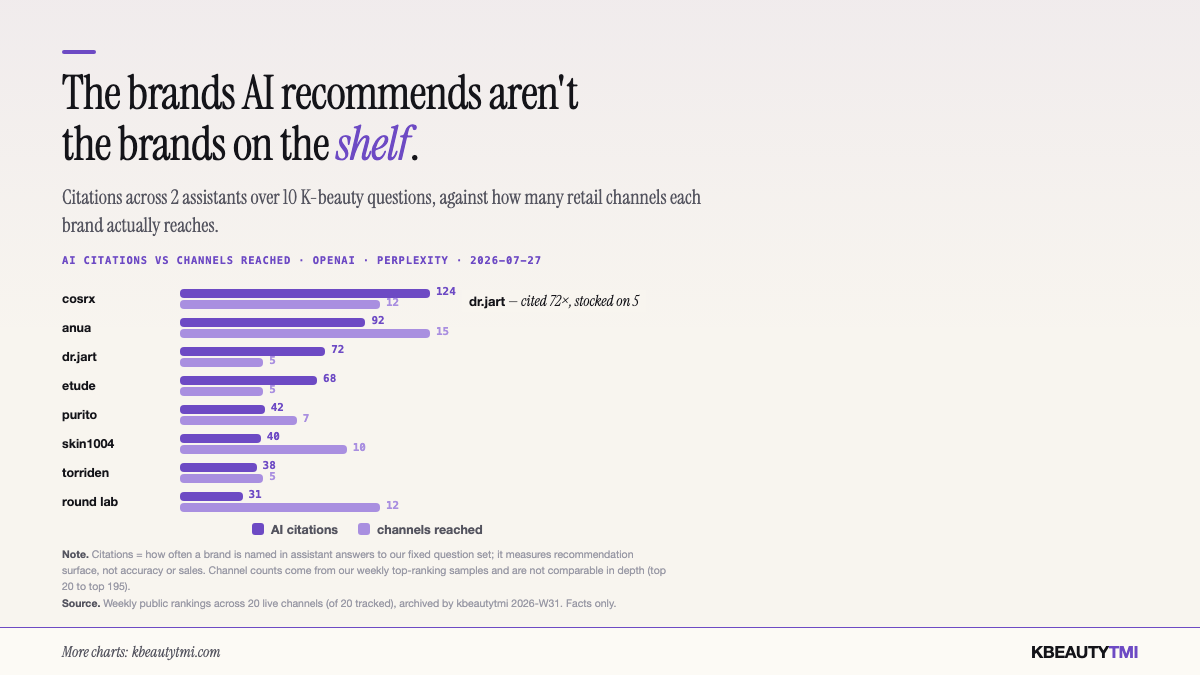
The brand AI names most in our latest read collected 124 mentions — more than any other. It's a name that fills English-language routines and gets written about constantly. That's precisely the profile you'd expect a planner to surface: not the highest-selling item in Seoul, but the most talked-about one online, because that's the text these systems learned from. The planner recommends what the internet discusses.
Which is why we keep it on its own list
The chart above sets that answer next to reality: how often a brand is named by AI, and separately, how widely it actually charts across retailers. We never merge the two. A brand the planner loves may not have reached the shelf yet; a brand deep on the shelf may be one the planner never mentions. Both facts are useful, and both are easy to abuse if you blur them into a single "top brands" list.
The honest version is the gap. Watched weekly, it shows the discovery layer and the buying layer moving toward or away from each other — which is the closest thing there is to an early read on what crosses over next. The planner is telling shoppers something. We just think you should be able to check it against the shelf.
"AI is the new planner. Here's what it plans with K-beauty." — kbeautytmi, 2026-W31. https://kbeautytmi.com/stories/ai-is-the-new-planner
↗ Chart image — free to use with credit Free to cite — rankings can't be collected retroactively, so this archive exists nowhere else.