AI recommends a brand 25 times. It's on one shelf.
We ask four AI assistants the same 60 K-beauty questions each week and count which brands the answers name. Some brands the assistants recommend heavily are barely on a shelf: Dr.Jart+ is cited 25 times and charts on exactly one of our 15 channels.
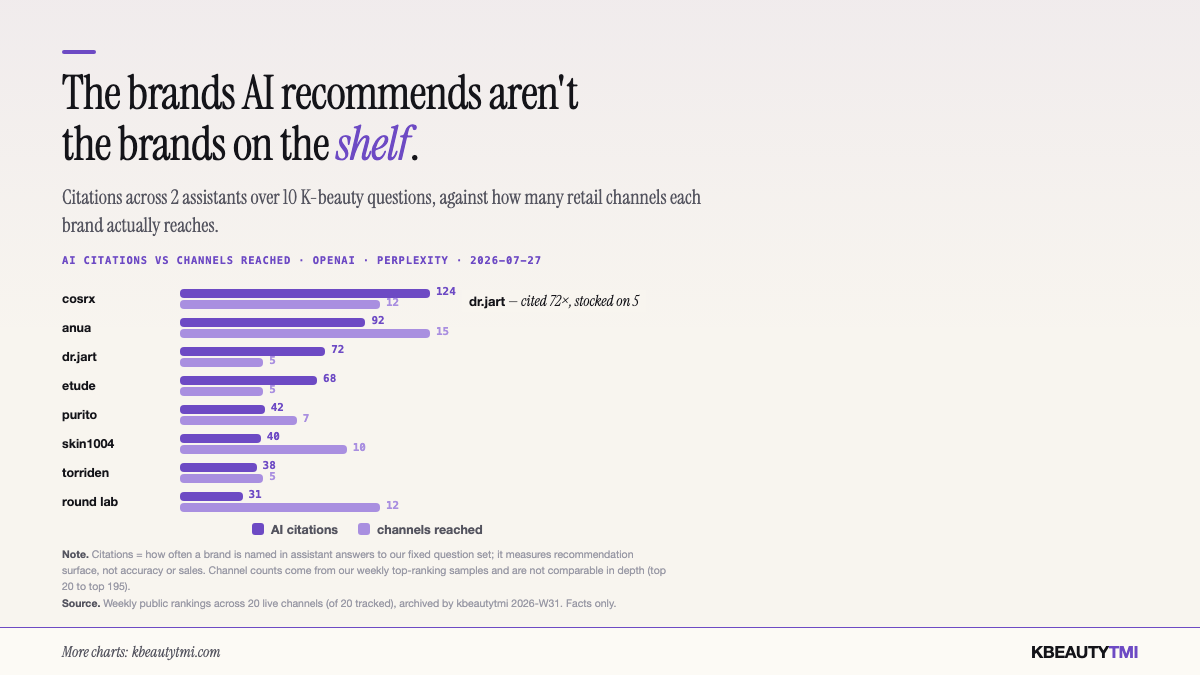
Increasingly the first place a shopper hears a brand name is an AI answer, not a shelf. So we measure both, and the gap between them is its own signal.
Each week we put the same 60 K-beauty questions to four assistants and count which brands get named. Then we join that against how many of our 15 retail channels each brand actually charts on.
Two brands, two different problems
Anua is the aligned case: 36 citations, 11 channels. The assistants recommend it and a shopper can find it almost anywhere we look. COSRX is the same shape at 34 and 9.
Dr.Jart+ is not. 25 citations — third most-cited brand on our board — and it charts on exactly one channel (Sephora). LANEIGE shows the same pattern at 15 citations and 2 channels.
These are brands with high recommendation surface and narrow shelf presence. A shopper who asks an assistant for a K-beauty recommendation is being pointed at products that, on our charts, are hard to run into by browsing.
Which way does the causation run?
Honestly: we do not know yet, and one week of data cannot tell us. Both stories are plausible. These are established brands with long review histories and heavy editorial coverage, which is exactly the material assistants draw on — so citation may simply lag distribution history rather than predict it. Or recommendation surface may be running ahead of the shelf, in which case the shelf is the thing that moves next.
What makes it worth tracking is that the two are measurable separately, weekly, and they clearly do not move together.
What we'll watch next
The testable version: if citation leads distribution, brands with a high cite-to-channel ratio should add channels in the following weeks. From W30 we can check that directly — and if the ratio predicts nothing, we will publish that too.
"AI recommends a brand 25 times. It's on one shelf." — kbeautytmi, 2026-W29. https://kbeautytmi.com/stories/ai-recommends-brands-the-shelf-doesnt-carry-2026-w29
Free to cite — rankings can't be collected retroactively, so this archive exists nowhere else.