Allure's editors picked 153 skincare products. Nineteen are Korean.
Editor lists and sales charts are different instruments. We counted one editor list the way we count a shelf — product by product — and then checked how many of its Korean brands actually turn up on the US charts we archive every week.
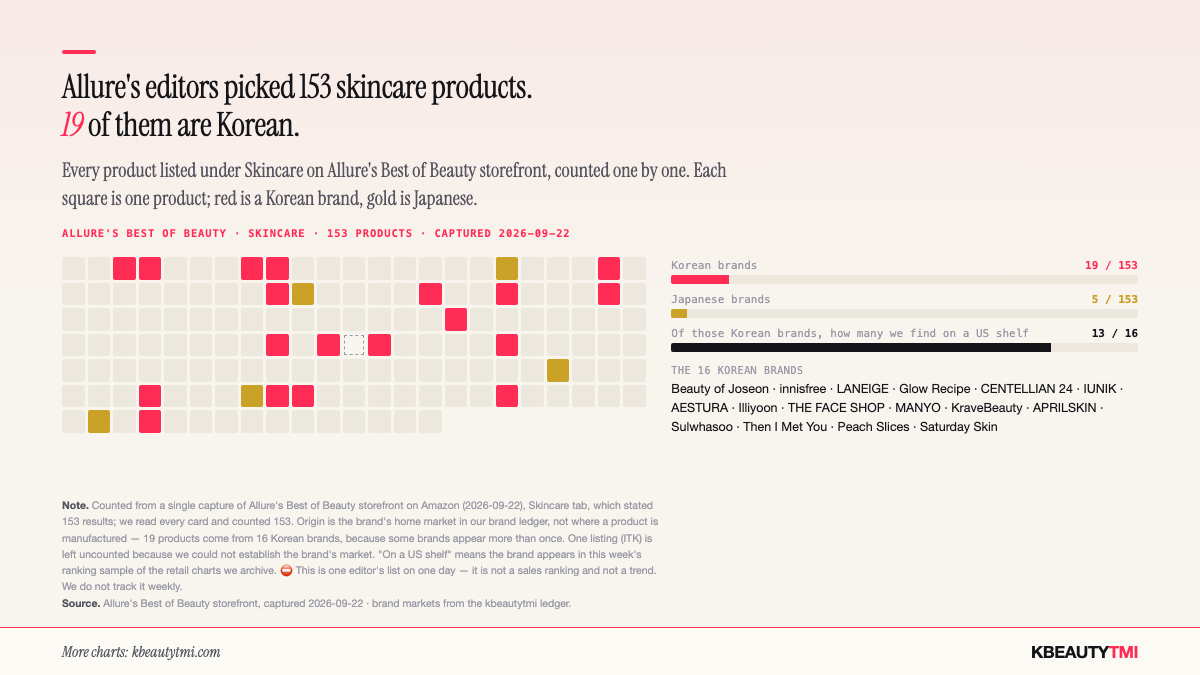
Allure runs a Best of Beauty storefront on Amazon. On September 22, 2026 its Skincare tab said 153 results. We read every card and counted 153 products, then marked each one by the brand's home market in our ledger.
Nineteen products are from Korean brands — 12.4% of the list. They come from 16 brands, because a few appear more than once: AESTURA and THE FACE SHOP each place two products, and Peach Slices places two.
The list is not the shelf
An editor list says what a magazine will vouch for. A best-seller chart says what people put in a basket. We keep the second kind every week, so we can ask a question the list itself cannot answer: do these picks show up where people actually buy?
Of the 16 Korean brands on Allure's list, 13 appear on at least one of the retail charts we archive this week. Beauty of Joseon reaches nine of them and AESTURA seven — those two are not editor discoveries, they are already standing on shelves. At the other end, three brands on the list — APRILSKIN, KraveBeauty and Peach Slices — do not appear in this week's ranking sample at all. That is not a verdict on them. Our samples run from the top 20 to the top 100 depending on the retailer, so absence from a chart is not absence from a store.
The other aisle
Five products on the list are Japanese — Shiseido three times, plus SK-II and Bioré. Counting them mattered for a reason that has nothing to do with Japan: while checking this list we found that our own board had been painting Bioré, a Kao brand, as Korean. It sits on two Korean-beauty shelves we track, and our code had been reading "on a K-beauty shelf" as "is a Korean brand." A British brand, BYOMA, had been mislabelled the same way. Both are corrected, and the rule is now explicit: a brand's home market comes from our ledger, never from the shelf it happens to sit on.
What this is and is not
This is one list, captured on one day, from one storefront. It is not a sales ranking, it is not a trend, and we do not track it weekly — which is exactly why the number is printed with its denominator and its date attached. One listing, from a brand called ITK, is left out of the count because we could not establish the brand's home market. We would rather publish 19 we can defend than 20 we cannot.
"Allure's editors picked 153 skincare products. Nineteen are Korean." — kbeautytmi, 2026-W39. https://kbeautytmi.com/stories/allure-picked-153-skincare-products-19-are-korean-2026-w39
↗ Chart image — free to use with credit Free to cite — rankings can't be collected retroactively, so this archive exists nowhere else.