K-beauty is on America's beauty shelves — barely on its everyday ones.
K-beauty has reached America's beauty-specialist shelves and barely stepped onto its everyday ones. On the best-seller charts it is 11–15% of Amazon, Ulta and Sephora — roughly one product in seven to nine — and about one in forty on Target's mass shelf.
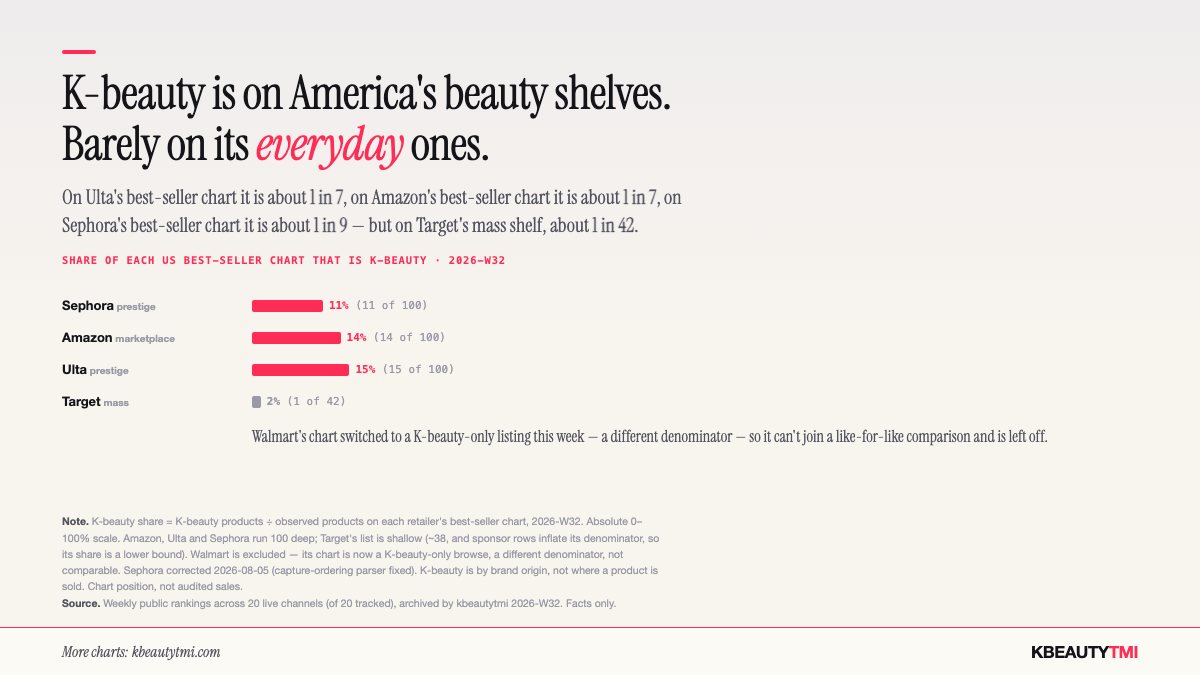
K-beauty has reached America's beauty-specialist shelves and barely stepped onto its everyday ones. On the best-seller charts it makes up about 14% of Amazon, 15% of Ulta and 11% of Sephora — a routine one product in seven to nine on the shelves where Americans go looking for beauty. Walk into the everyday aisle instead, at Target, and it is about one in forty. The gap between the beauty shelf and the everyday shelf is the real state of the K-beauty boom in the US.
How far into US retail has K-beauty actually reached?
As far as the beauty specialists, and evenly across them. Amazon, Ulta and Sephora each run K-beauty at 11–15% of their best-seller charts — a consistent, routine part of the assortment on the counters where beauty is the reason you came. There's no single breakout channel and no specialist laggard; the category has simply arrived on the shelves built for discovery.
Where does it stop?
At the mass shelf. On Target's best-seller chart K-beauty is about one product in forty — and because sponsor rows pad that list, the true share is a touch higher, but the shape is clear: everything around it is American drugstore skincare, CeraVe, La Roche-Posay, Neutrogena, Cetaphil. These are the shelves people reach for on a grocery run, buying the default rather than the discovery, and there K-beauty is still a rounding error. (Walmart would be the other mass data point, but its K-beauty chart changed this week to a category-only listing we can't compare like-for-like, so we've left it out rather than fake the number.)
Why the cliff between the two?
Because the two shelves answer different questions. The specialist shopper is choosing — comparing actives, following a trend, willing to try the Korean option — and K-beauty wins choices. The mass shopper is defaulting — grabbing the barrier cream they already know — and defaults in US skincare are still CeraVe and La Roche-Posay, not COSRX. Crossing from the specialist shelf to the mass one is the hard part of any beauty category, and K-beauty has made the first crossing and not yet the second.
What this does and doesn't tell you.
It compares shares, not raw counts, on purpose. The charts have different depths — Amazon, Ulta and Sephora run 100 deep, Target's list is shallow (~38) — so the figures are read as rates, and Target's is a lower bound. K-beauty here means brand origin, not where a product happens to be sold, which is why The Ordinary and CeraVe — sold in Korea, but not Korean — don't count. These are best-seller ranks, not sales figures, and a brand absent from a chart can still be bought in that store. What holds is the shape: on America's beauty shelves K-beauty is roughly one in seven to nine; on its everyday shelves, one in forty.
"K-beauty is on America's beauty shelves — barely on its everyday ones." — kbeautytmi, 2026-W32. https://kbeautytmi.com/stories/k-beauty-is-on-americas-beauty-shelves-not-its-everyday-ones-2026-w31
↗ Chart image — free to use with credit Free to cite — rankings can't be collected retroactively, so this archive exists nowhere else.