K-beauty just gained ground on America's beauty shelf.
The US mainstream beauty shelf moves slowly — that's what makes it the shelf. So when Korean brands add ten products across the four big American best-seller charts in a single week, and nearly double their share at Sephora, it's worth stopping on. This week the shelf moved, and it moved their way.
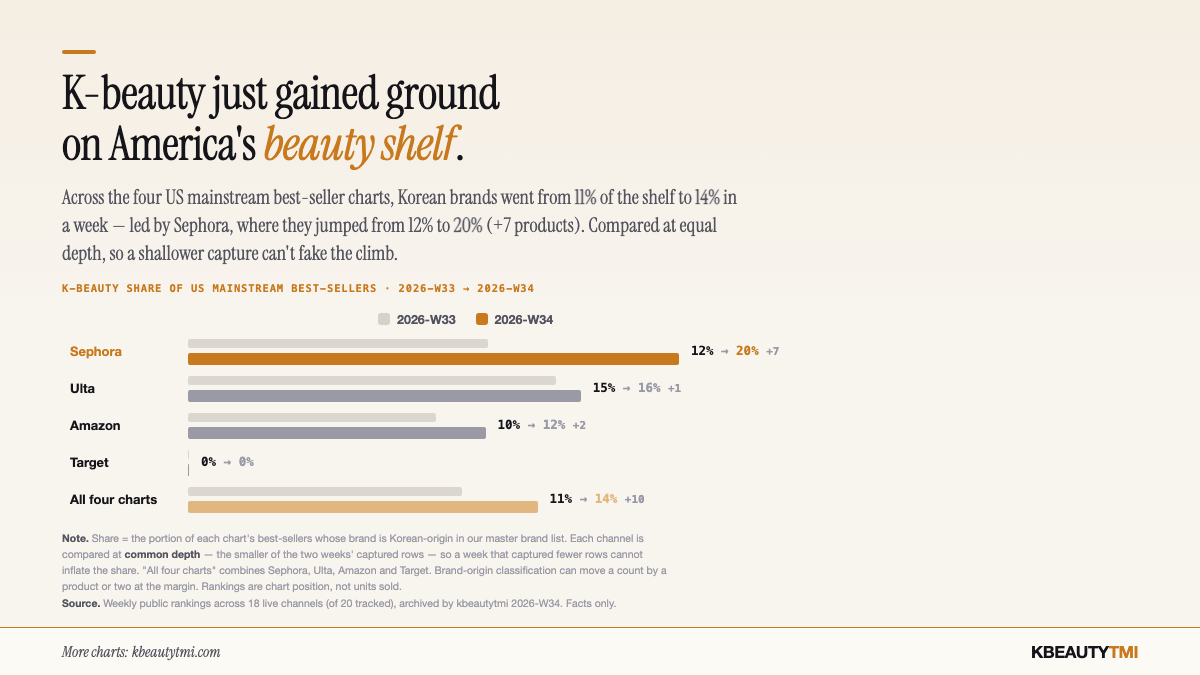
Most weeks, the story of America's mainstream beauty shelf is that nothing much happened — a product slides a rank or two, the leaders hold. That inertia is the point of a mass-retail chart; it takes real demand to move one. Which is why this week stands out: across the four big US best-seller charts, Korean brands didn't hold steady. They gained.
Sephora did the heavy lifting
The clearest move is at Sephora, where K-beauty went from 12% of the best-sellers to 20% in a week. That's not a trick of a shorter list — the actual count of Korean products on the chart rose from 11 to 18. Ulta ticked up one, Amazon two. Add the four charts together and Korean brands went from 11% of the shelf to 14% — ten more products than the week before.
Why we can say it's real
A rising share is easy to fake by accident: if a chart simply captured fewer rows this week, the percentage can climb while nothing actually changed. So we don't compare a shorter list to a longer one. Every channel here is measured at common depth — the smaller of the two weeks' captured rows — so both weeks are judged on the same number of slots. Sephora's jump survives that test, and it shows up in the raw count, not just the percentage. This is the difference between a shelf that moved and a ruler that shrank.
It wasn't everywhere
One honest line, because the gain wasn't uniform: at Target, K-beauty held zero best-seller slots — this week and last. The mass-grocery end of the shelf still isn't reaching for Korean brands the way the beauty-specialty end is. A single week is a data point, not a trend; next week could give some of this back. But the shape of the move is familiar — it's strongest exactly where beauty enthusiasts shop (Sephora) and absent where the everyday grocery run happens (Target), which is the same split we see everywhere in this data.
Why the weekly cadence matters
You only get to see a move like this if you read the same shelf the same way every week and keep the receipts. A single snapshot would show you 20% at Sephora and call it a fact; two snapshots, measured identically, show you it was 12% seven days ago — and that the change, not the level, is the news.
"K-beauty just gained ground on America's beauty shelf." — kbeautytmi, 2026-W34. https://kbeautytmi.com/stories/k-beauty-just-gained-ground-on-americas-beauty-shelf-2026-w34
↗ Chart image — free to use with credit Free to cite — rankings can't be collected retroactively, so this archive exists nowhere else.