K-beauty was wellness before wellness was a shelf
American retail just decided skincare belongs in the wellness aisle. It's treated as a new idea. On Korea's shelf, it's the oldest one there — you can read it in the ingredients.
Late in July, Ulta Beauty did something small that says a lot. It launched a new skincare line, Good Day, and chose not to shelve it in skincare at all — it put it in the wellness aisle, next to supplements and sleep aids, and merchandised it around mood (BeautyMatter, 2026). Wellness is now Ulta's second-largest category behind cosmetics, about a quarter of sales. The wall between skincare and wellness, the retailer said, keeps coming down in the mind of the shopper.
It's framed, understandably, as a frontier. But if you read Korea's best-seller shelf the way we do every week, the frontier looks a lot like a place someone already lived.
The vocabulary was already on the label
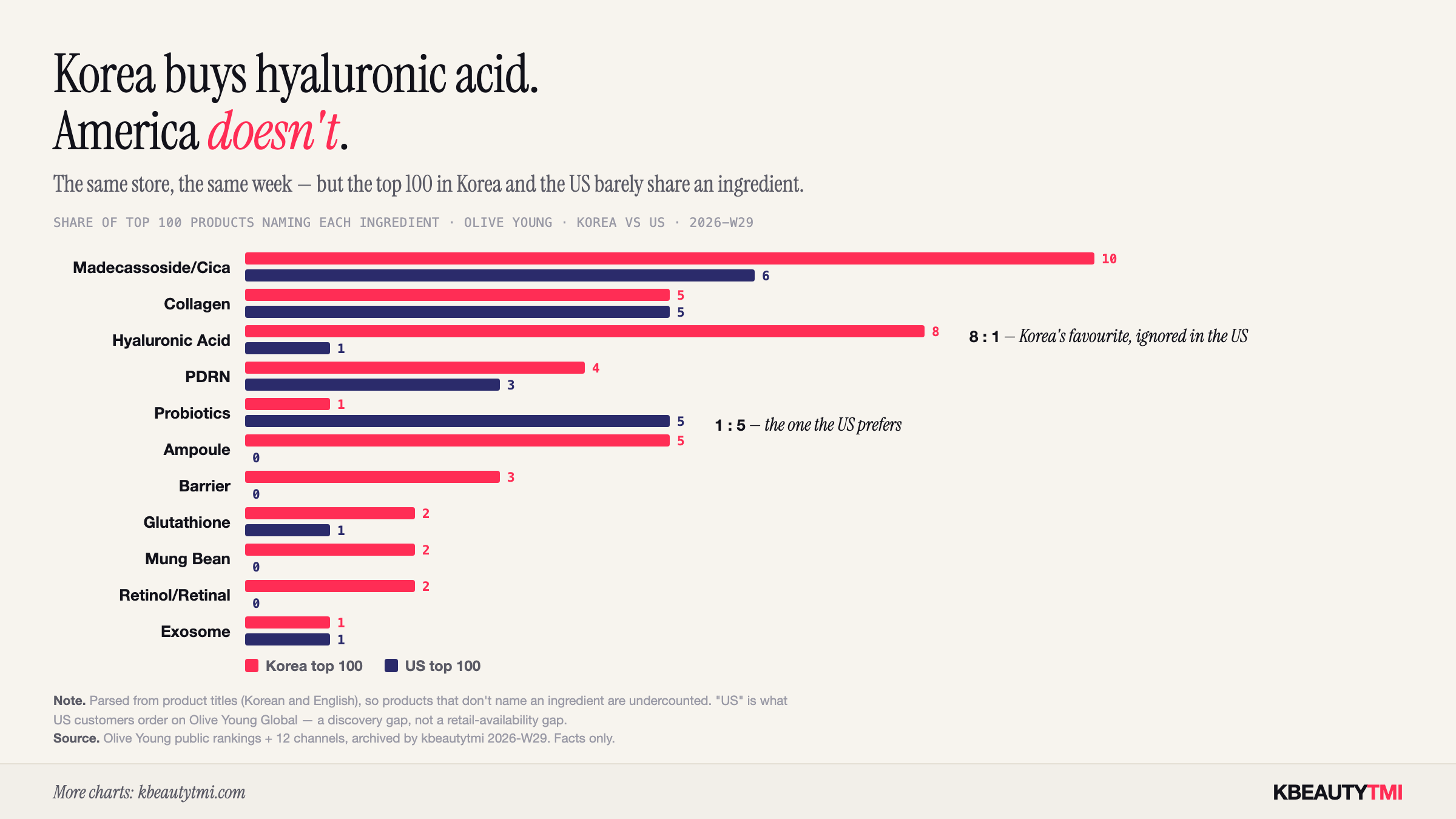
K-beauty never marketed skincare as pure vanity. Its whole grammar is health-adjacent: barrier, calming, soothing, ingredients borrowed from the pharmacy and the herb garden. You don't have to take our word for it — it's in what the products are literally named. In our latest read of Olive Young Korea's top 100 against the US shelf, the calming-and-barrier family leans sharply Korean. Cica (madecassoside) shows up on roughly twice the share of Korea's chart as America's; heartleaf, the quiet workhorse of Korean routines, barely registers on the US list at all.
That's the chart above. It isn't a claim about what works — we read the marketing on the label, not the clinical file. It's a claim about language: the words Korea has been putting on its bestsellers for years are the exact wellness-coded words American retail is now building an aisle around.
Why the shelf got there first
None of this is because Korea planned to win a category the West hadn't named yet. It's that the routine itself — many light steps, barrier before brightening, "skin health" as the goal rather than a finished face — was always closer to a wellness practice than a makeup one. When the American shopper started asking skincare to signal sleep, stress and hydration, they were asking it to do a job Korea's shelf had quietly been advertising the whole time.
So the convergence everyone's calling new reads, from here, like a catch-up. The interesting question isn't whether beauty and wellness merge — that's decided. It's which of Korea's already-wellness-coded ingredients crosses over next, and which stays home. That gap, week to week, is the thing this site exists to watch.
The honest caveat
One line we won't cross: a name on a label is prominence, not proof. Cica leading Korea's shelf tells you what Korean marketing leans on, not that any jar heals your barrier — and the same generation driving the wellness shift has gotten sharp about that difference. We keep the receipts on what the shelves say. What it does to your skin is between you and the evidence.
"K-beauty was wellness before wellness was a shelf" — kbeautytmi, 2026-W31. https://kbeautytmi.com/stories/kbeauty-was-wellness-first
↗ Chart image — free to use with credit Free to cite — rankings can't be collected retroactively, so this archive exists nowhere else.