Niacinamide is the ingredient America ranks more than Korea does.
Most ingredients we track lean the same way: Korea stocks them and the US hasn't caught up. Hyaluronic acid and centella both run 9 to 3 in Korea's favor this week. Niacinamide breaks the pattern hardest — the US sample ranks four niacinamide products to Korea's one, the widest reversed gap on our board.
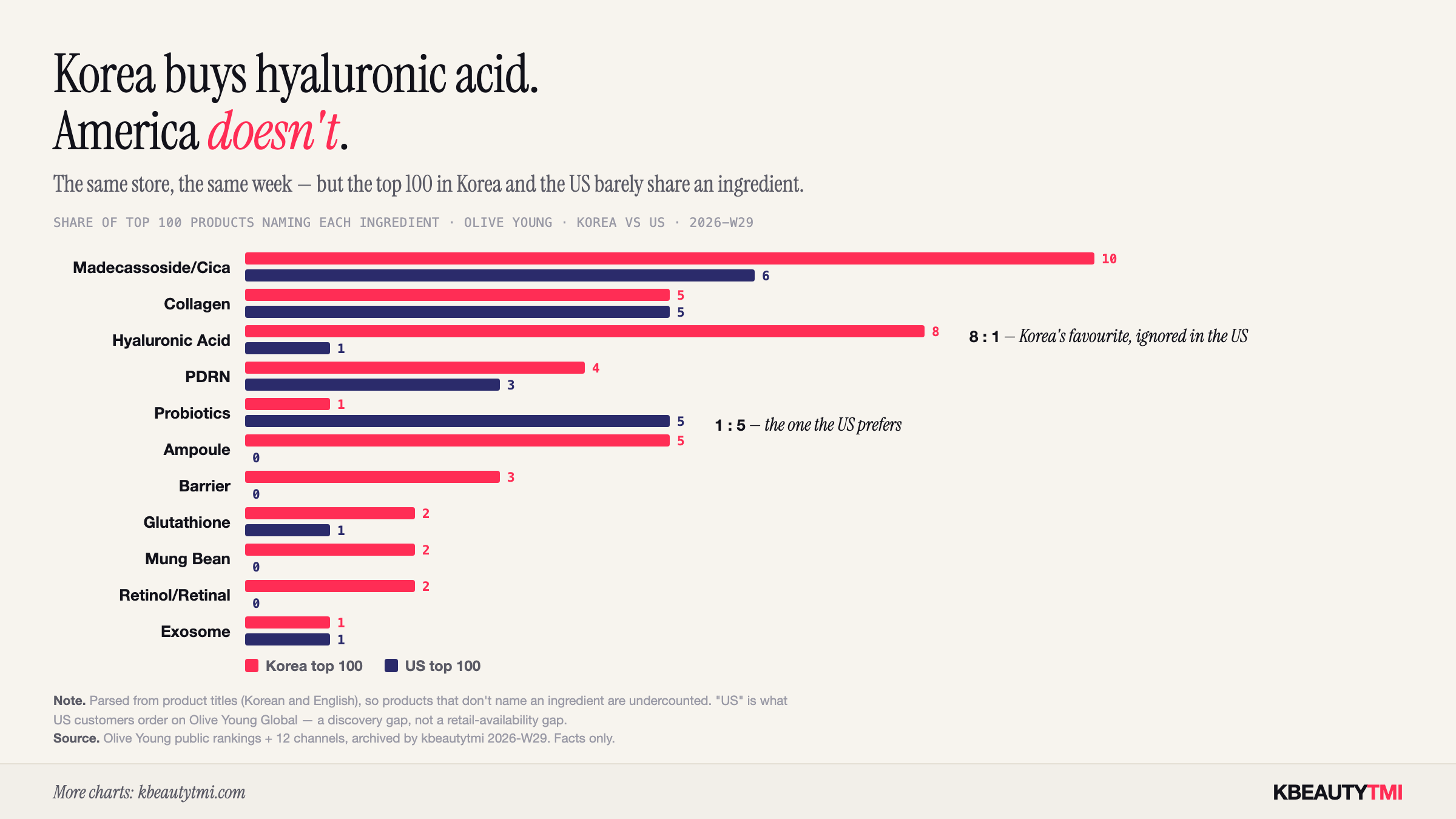
Our Ingredients board has one dominant direction: Korea leads, the US follows. Hyaluronic acid, centella, heartleaf — each shows more products in Korea's top 100 than in what US customers order. The easy read is a discovery gap: America hasn't found what Korea already buys.
Niacinamide is where the current runs backward. This week the US sample ranks four niacinamide-named products to Korea's one — a gap of -3, the widest reversed gap on the board. The brightening, pore-refining active that American routines have leaned on for years out-indexes it, relative to Korea's home chart, more than any other ingredient we track.
What a reversed gap means
A negative gap is not proof that Americans love niacinamide more than Koreans do in absolute terms. It is proof that, among the products US customers actually rank on Olive Young Global, niacinamide formulas punch above their weight relative to Korea's top 100. The demand signal lives on the buying side, not the shelf side — and here it points at an active the US market already knows how to shop for.
The contrast sharpens it
Set it against hyaluronic acid and centella, both running 9 to 3 in Korea's favor this week, or heartleaf at 5 to 0. The rule — Korea over-indexes — holds almost everywhere. Niacinamide, and a short tail of actives like PHA/LHA, are the exceptions that make the map worth reading. When one ingredient points the opposite way from the rest, it is telling you something about who is doing the choosing.
The limits, stated first
These counts are parsed from product titles, so a formula that doesn't name its active is undercounted, and small counts (one versus four) move easily week to week. "US" here is what US shoppers order on Olive Young Global — a discovery gap, not a retail-availability gap. And a single week is weather, not climate: niacinamide may settle back level next week. But this week, on the one board where America usually trails, it leads.
"Niacinamide is the ingredient America ranks more than Korea does." — kbeautytmi, 2026-W30. https://kbeautytmi.com/stories/niacinamide-america-ranks-it-more-than-korea-2026-w30
↗ Chart image — free to use with credit Free to cite — rankings can't be collected retroactively, so this archive exists nowhere else.