One brand owns Korea's face-mask shelf. In America, no one does.
Sheet masks are the most fragmented-looking category in K-beauty — hundreds of brands, dozens of formats. But on Korea's chart it isn't fragmented at all: MEDIHEAL holds 7 of the top 20 slots, including the top three. On the US chart, the leading brand holds three, and no one owns the category.
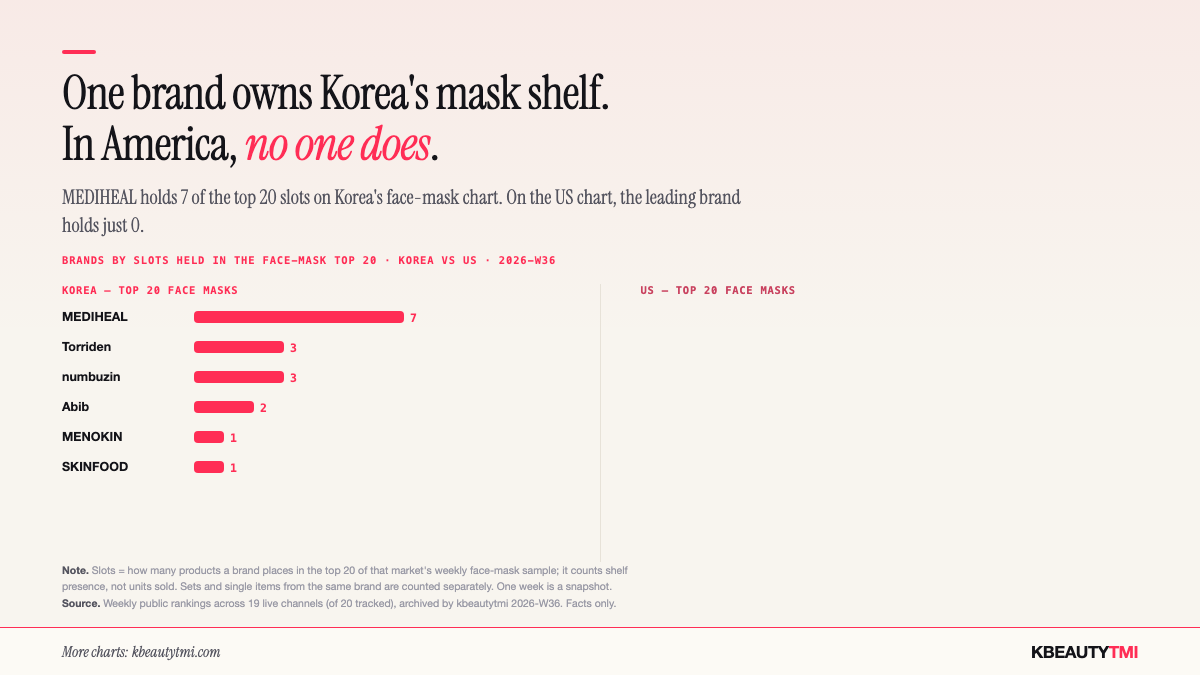
Concentration is a thing you can only see once you're counting the whole shelf. This week the face-mask category shows two opposite shapes on either side of the Pacific. In Korea, it is a near-monopoly of attention: MEDIHEAL places 7 of the top 20 products — the essential sheet-mask sets and toner pads that occupy the top three slots outright. The next brands, numbuzin, Abib and Torriden, manage three apiece.
Cross to the US chart and the picture inverts. The leading brand — COSRX or BIODANCE, tied at three slots — leads a crowd. d'Alba, REJUDEX and Torriden trail with two, and the rest of the top 20 is a scatter of single placements. No one owns the American mask shelf.
Why one market concentrates and the other doesn't
A home market rewards the incumbent: MEDIHEAL has spent years as the default Korean sheet mask, and Olive Young's chart reflects a shopper reaching for the known quantity in bulk. A destination market rewards the breakout: US charts are shaped by whatever crossed over and caught on — a viral overnight collagen mask here, a toner pad there — with no single brand having had time to become the default. Concentration is the signature of a settled category; fragmentation is the signature of one still sorting itself out.
What it means for a brand deciding where to push
The strategic read cuts both ways. In Korea, dislodging MEDIHEAL from the mask shelf is brutally hard — the concentration is the moat. In the US, the same category is wide open: three slots is enough to lead, which means a brand with a distinctive format and a moment can take real ground before an incumbent forms. The gap between the two charts is where that opportunity lives.
The limits, stated first
Slots count how many products a brand places in the top 20 of each market's weekly face-mask sample — shelf presence, not units sold. Sets and single items from the same brand count separately, which flatters brands that sell many SKUs. "US" is what US customers order on Olive Young Global, one window onto the American market rather than all of it. And a single week is a snapshot; concentration can loosen or tighten as the chart turns over.
"One brand owns Korea's face-mask shelf. In America, no one does." — kbeautytmi, 2026-W30. https://kbeautytmi.com/stories/one-brand-owns-koreas-mask-shelf-america-none-2026-w30
↗ Chart image — free to use with credit Free to cite — rankings can't be collected retroactively, so this archive exists nowhere else.