Only 15 of Korea's 100 best-sellers sell at full price.
Korea's best-seller chart is a discount chart. Of the 100 products on Olive Young Korea's top-100 list for 2026-W31, 85 are marked down from their list price and only 15 sell at full price — and among the discounted, the typical cut is 28%, with 40 of the 100 at least 30% off.
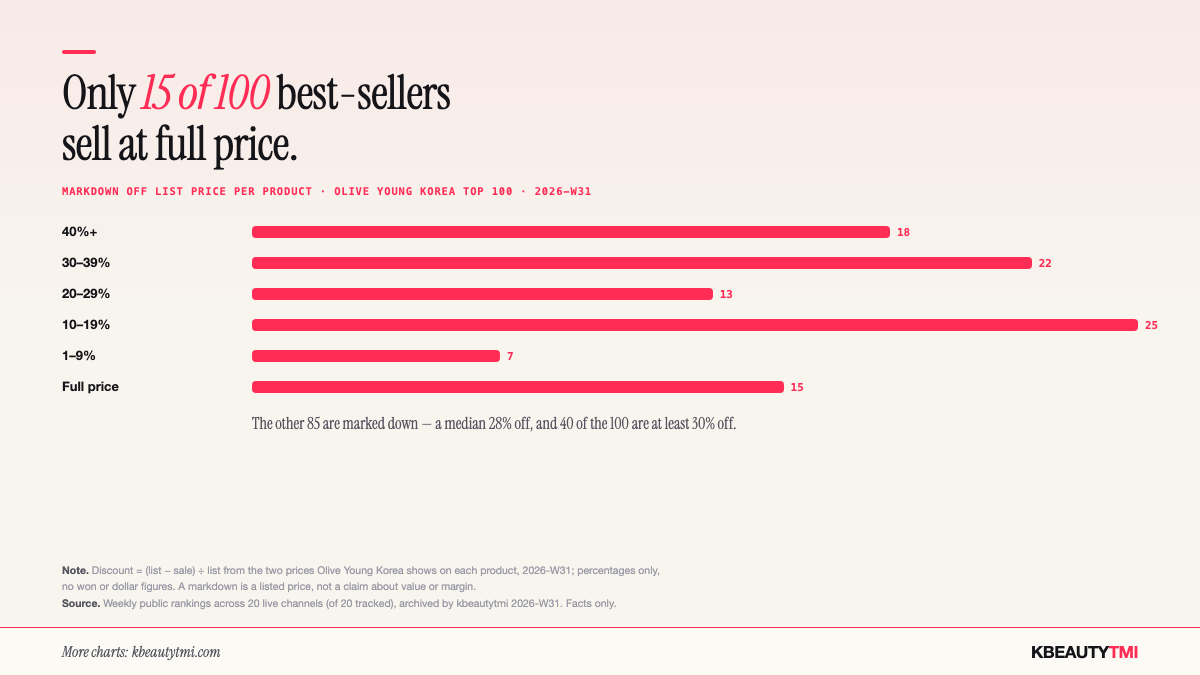
Korea's best-seller chart is a discount chart. On Olive Young Korea's top-100 list for 2026-W31, 85 of the 100 products are marked down from their list price and only 15 sell at full price. Read alongside the packaging pattern — 77 of the same 100 are sold as sets or multipacks — it points to one habit: what tops Korea's shelf is rarely a single item at a single price. It is more units, at a lower one.
How much of the chart is on sale?
Almost all of it. 85 of the 100 top-selling products carry a markdown off their listed price, and only 15 sell at full price. The full-price fifteen are a mix of the very new and the very cheap — items where there is little room or little need to discount — but everywhere else, a cut price is the normal state of a best-seller, not a temporary event. On Korea's largest health-and-beauty shelf, not being on sale is the exception.
How deep do the cuts go?
Deeper than a token discount. Among the 85 discounted products the median markdown is 28%, and the cuts cluster in the middle and high end of the range: 25 products are 10–19% off, 13 are 20–29% off, 22 are 30–39% off, and 18 are at least 40% off. That means 40 of the 100 best-sellers — two in five — are marked down 30% or more. The steepest this week are an Anua niacinamide serum at 57% off (#21) and a numbuzin sheet-mask set at 56% (#63): both are also multipacks, which is where the two levers meet.
Where do discounts and bundles overlap?
They stack. The products that discount hardest are usually the same ones sold in bulk — mask packs, toner-pad doubles, serum sets — so a shopper sees both a lower unit price and more units in a single listing. That combination is a large part of what pushes these items up a best-seller rank, which is a velocity signal: how much is moving now. It is why the chart can look, at a glance, less like a ranking of the best products and more like a ranking of the best offers running this week.
What this does and doesn't tell you.
It reads the listed markdown, not the real saving. The discount is computed as (list price − sale price) ÷ list price from the two figures Olive Young Korea shows on each product for 2026-W31 — so a 40% markdown means the listing states a 40% cut off its own list price, not that the item is 40% cheaper than anywhere else, and not a claim about the retailer's margin. We report percentages only and never the won or dollar amounts. One retailer is not the whole Korean market, and list prices can be set to make a discount look larger. What the number does establish is structural and stable enough to track weekly: on Korea's best-seller chart, the discount is not the exception — it is the format.
"Only 15 of Korea's 100 best-sellers sell at full price." — kbeautytmi, 2026-W31. https://kbeautytmi.com/stories/only-15-of-koreas-100-best-sellers-full-price-2026-w31
↗ Chart image — free to use with credit Free to cite — rankings can't be collected retroactively, so this archive exists nowhere else.