Proof, not hype: why we keep the receipts
A note on why this site looks the way it does. A generation of shoppers has started treating polish itself as a warning sign — and asking for the one thing we were already built to keep: receipts.
Every so often a piece of outside research lands that reads less like news and more like a mission statement someone else wrote for you. A recent study of Gen Z and Gen Alpha — Cafeteria's Gen Next Talks Health & Wellness, reported by BeautyMatter — was one of those for us. Its finding about trust is, almost word for word, the reason this site works the way it does.
The generation that treats polish as a warning
The study found that younger shoppers now assume a product claim may be misleading until evidence proves otherwise. What earns their trust is research, clinical testing, measurable results, and third-party reviews that carry both criticism and praise. What loses it is the opposite: unverifiable claims, sponsored praise, promo codes, and — tellingly — AI-generated imagery and copy, which drew extra suspicion. The gloss that used to sell now reads as a reason to doubt.
Read that list of red flags again and you're looking at a description of a lot of the beauty internet. The shift isn't that young shoppers stopped caring about skincare. It's that they stopped taking anyone's word for it, and started asking to see the workings.
So we publish the workings, not opinions
That's the whole design of this place. Instead of telling you what's good, we keep the receipts. Every week we save the best-seller charts that retailers already publish — Olive Young in Seoul, Sephora, Ulta, Amazon, TikTok Shop in the US — and we date and source every one of them. That matters more than it sounds, because rankings can't be reconstructed after the fact: miss a week and it's gone. The archive is the proof. It only exists because someone chose to write it down before it vanished, and it's checkable against the same public pages we pulled it from.
Two rules that keep it proof, not hype
First, we witness, we don't predict. When a number surprises us, we assume a parser bug before we assume a story; when we do forecast, we label the confidence and publish the misses next to the hits. Second, we say exactly what a number is. A best-seller rank tells you what a store surfaced — not how many units moved — and we label it that way rather than dressing it up as something bigger. Neither rule is a favor to anyone. They're just what honesty looks like when the whole point is the receipt.
The same instinct is why we count AI twice
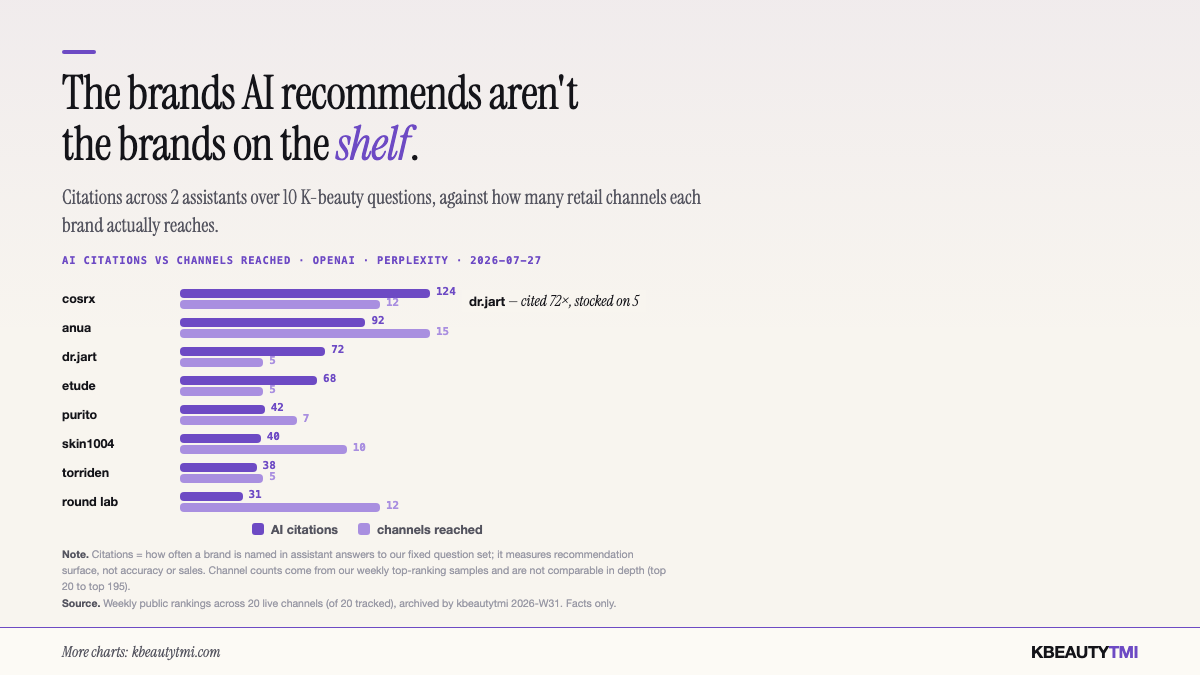
The study had one more finding that maps onto our work: this generation is wary of AI as an authority but open to it as a planner — for comparing products and building routines, not for diagnosis. That's the exact layer we measure. We track how often AI assistants name each K-beauty brand, over a fixed question set, and we keep it on a separate list from what actually charts on the shelf.
The chart above is that split made visible. One column is how often a brand gets named; the other is how widely it actually charts. We refuse to merge them, because merging them is the exact sleight of hand the hype economy runs on — turning "an assistant mentioned it" into "it's a best-seller." Kept apart, the gap between the two becomes the most honest thing on the page: a brand AI loves that the shelf hasn't caught up to, or a shelf staple AI never names. Two measurements, labeled, so you can trust each for precisely what it is.
What we're promising ourselves
We won't dress a guess up as a finding. We won't quietly restate the archive to make a cleaner story. We won't publish a claim we can't point back to a public, dated source. The archive is the product, and the only thing that makes an archive worth keeping is that everything in it can be checked. A generation just told the whole industry what it wants: proof, not hype. We happened to already be building the proof. This journal is where we'll keep saying so out loud.
"Proof, not hype: why we keep the receipts" — kbeautytmi, 2026-W31. https://kbeautytmi.com/stories/proof-not-hype
↗ Chart image — free to use with credit Free to cite — rankings can't be collected retroactively, so this archive exists nowhere else.