Korea and the world buy different K-beauty — packaged and priced identically.
Korea and the rest of the world buy different K-beauty products, but through an identical promotional machine. On the 2026-W31 charts, Korea's top 100 and the worldwide top 100 are bundled at the same rate (77 each), discounted at the same rate (85 each) and marked down by the same typical amount (28%) — yet only 30 of the 100 products appear on both lists.
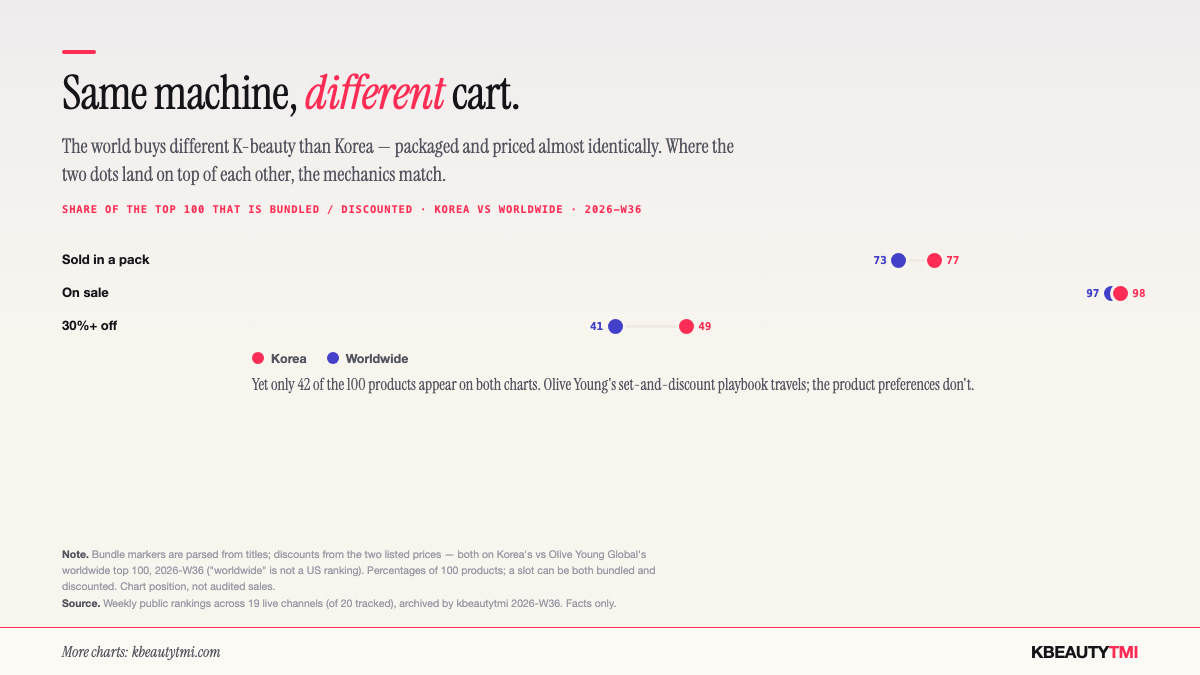
Korea and the rest of the world buy different K-beauty, but they buy it through an identical machine. Across this series we've mapped Korea's own best-seller chart and Olive Young Global's worldwide chart and found the products, brands and ingredients diverge sharply — only 30 of the 100 products overlap. The merchandising, though, is a near-perfect match: the same share is bundled, the same share is discounted, and the typical markdown is the same. The cart changes from market to market; the machine that fills it does not.
Does the worldwide chart bundle and discount like Korea's?
Almost to the product. 77 of Korea's top 100 carry a set, pack or offer marker — and so do exactly 77 of the worldwide top 100. 85 of each are marked down from list price. 40 of each are at least 30% off. The median markdown on both charts is 28%. Metric by metric, the two lists move in lockstep on how their best-sellers are packaged and priced, even though the underlying products are mostly different.
But is it the same K-beauty inside the packages?
No — that's the whole point of this series. Only 30 of the 100 products appear on both charts. The brands diverge: REJURAN leads the world at #1 but sits at #70 in Korea, while CLIO is a Korean top-five brand absent from the worldwide list. The ingredients diverge too: the world orders more PDRN and glutathione, Korea buys more heartleaf and centella. So the sameness is not in what sells — it is only in how whatever sells is presented.
What does the match actually mean?
It means the promotional format is the platform's, not the market's. Bundling and discounting at these rates is Olive Young's playbook — and both charts are Olive Young storefronts, so the retailer runs the same set-and-discount engine at home and abroad. Read carefully, that makes the finding a two-parter: the merchandising is a constant the retailer imposes, and the product mix is the variable each market chooses inside it. When we compare Korea to the world, the packaging and pricing cancel out, and what's left is a clean read on demand — which is exactly the layer worth watching.
What this does and doesn't tell you.
Both charts come from one company, so some of the match is by construction. Olive Young Korea and Olive Young Global are the same retailer's two storefronts; a shared merchandising strategy is part of why the bundle and discount rates line up, and the match might look different across unrelated retailers. "Worldwide" is Olive Young Global's international chart, not a US ranking. Bundle markers are parsed from titles and discounts from the two listed prices, both for 2026-W31 — percentages of 100 products, not unit sales, and a slot can be both bundled and discounted. What holds regardless is the structure: same shop, same promotions, different carts — and once you subtract the promotions, the carts are what these weekly snapshots are built to compare.
"Korea and the world buy different K-beauty — packaged and priced identically." — kbeautytmi, 2026-W31. https://kbeautytmi.com/stories/same-machine-different-cart-korea-vs-world-2026-w31
↗ Chart image — free to use with credit Free to cite — rankings can't be collected retroactively, so this archive exists nowhere else.