Sephora and Ulta share exactly one K-beauty brand.
Two US prestige retailers, both selling K-beauty, both with a best-seller chart we archive weekly. Sephora carries 16 Korean brands on its chart this week. Ulta carries 17. The overlap is one brand.
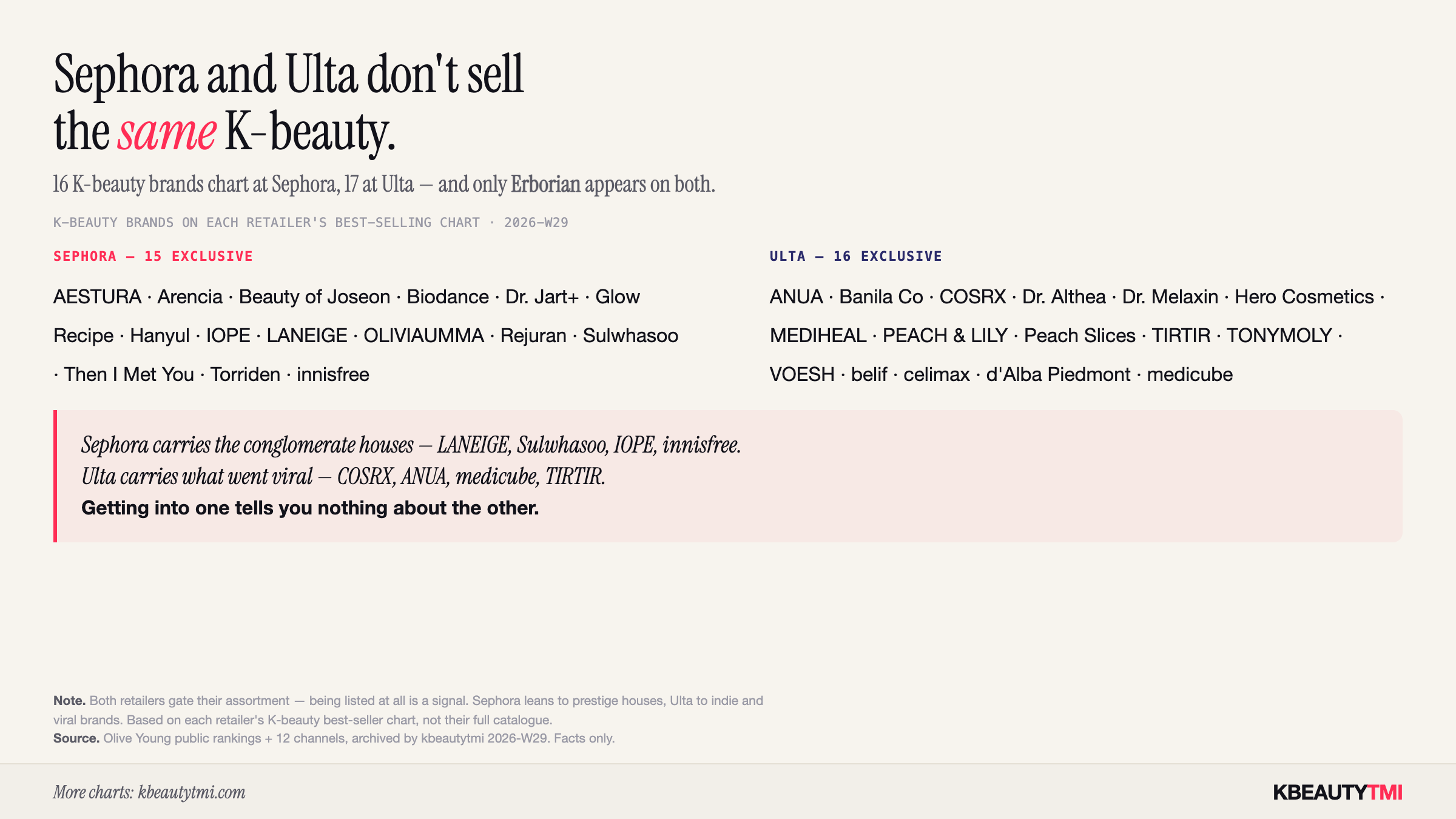
If you are a Korean brand trying to enter US prestige retail, the obvious mental model is a ladder: get into one prestige chain, prove yourself, then the other one follows. Our chart data says that model is wrong.
This week, 16 Korean brands appear on Sephora's K-beauty best-seller chart and 17 on Ulta's. Exactly one brand — Erborian — appears on both.
They are not competing for the same shelf
Look at who each retailer actually carries and the split stops looking random.
Sephora leans to conglomerate houses: LANEIGE, Sulwhasoo, IOPE, innisfree, AESTURA, Dr. Jart+. These are brands with corporate parents, prestige pricing, and existing global distribution.
Ulta leans to what went viral: COSRX, ANUA, medicube, TIRTIR, Peach & Lily, Banila Co. These are the brands that broke out on TikTok and Reddit before any buyer called them.
Those are two different acquisition paths. One is a corporate relationship; the other is demand a retailer cannot ignore. A brand optimised for the first is not automatically legible to the second.
What this means if you are watching a brand cross over
Getting listed at Sephora tells you almost nothing about Ulta, and the reverse is equally true. When trade coverage says a brand "entered US prestige retail," it is worth asking which gate — because on our charts they behave like separate markets that happen to share a country.
It also reframes what a second listing means. A brand that appears on both charts has done something structurally harder than doubling its distribution: it has satisfied two different buying logics. This week, one brand has.
What we'll watch next
From W30 our snapshots start producing movement, not just position. The question we can then answer: when a brand appears on one prestige chart, how often — and how fast — does the other follow? Right now the honest answer is that we have one week and one overlapping brand. Ask us again in a month.
"Sephora and Ulta share exactly one K-beauty brand." — kbeautytmi, 2026-W29. https://kbeautytmi.com/stories/sephora-ulta-share-one-brand-2026-w29
Free to cite — rankings can't be collected retroactively, so this archive exists nowhere else.