Star ratings don't sort Korea's chart. Everything that charts is already 4.5+.
A high star rating is the price of entry to Korea's best-seller chart, not the thing that wins it. Of the 98 rated products in Olive Young Korea's top 100 for 2026-W31, 96 score 4.5 or higher — and the top ten average 4.80 while the bottom ten average 4.72, a gap of less than a tenth of a star across the whole chart.
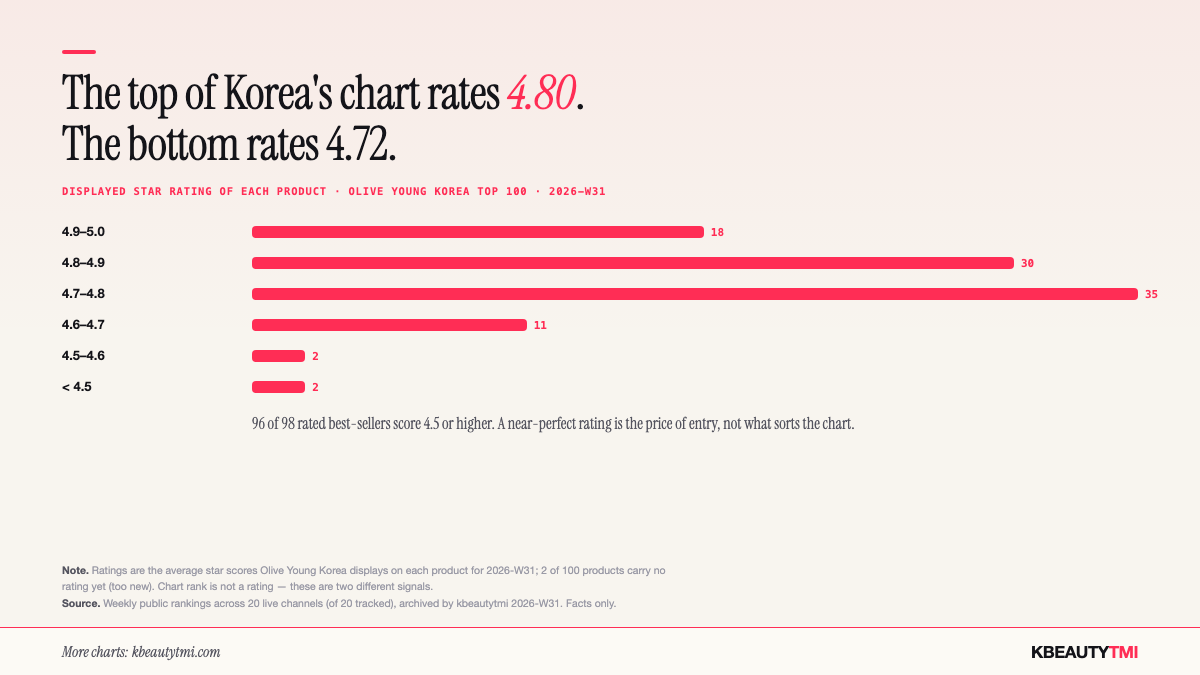
A near-perfect star rating is the price of entry to Korea's best-seller chart, not the thing that wins it. On Olive Young Korea's top-100 list for 2026-W31, 96 of the 98 rated products score 4.5 or higher, the median is 4.7, and the spread from the top of the chart to the bottom is almost nothing: the top ten average 4.80 and the bottom ten average 4.72. If you only had the ratings, you could not tell #1 from #91.
How high do the ratings run?
Almost uniformly high. Of the 98 top-100 products that carry a rating, 96 — 98% — sit at 4.5 stars or above; 83 of them are 4.7 or higher, and 18 rate 4.9 to a perfect 5.0. Only two rated products fall below 4.5, and two more (a Mamonde liquid mask at #86, a BB Lab supplement at #99) carry no rating at all because they are too new to have accumulated reviews. On Korea's largest health-and-beauty shelf, a product that has not already earned a near-perfect score essentially does not appear on the best-seller board.
Does a higher rating mean a higher rank?
Barely. The ten best-selling products average 4.80 stars; the ten at the bottom of the top 100 average 4.72. That is a difference of 0.08 of a star across 90 places of ranking. The #1 product of the week — MEDIHEAL's Essential Mask set — rates 4.9, which is high, but so do dozens of products that rank far below it. Whatever orders Korea's chart from 1 to 100, it is not the star rating: the ratings have already flattened into a narrow band near the top before the ranking even begins.
So what is doing the sorting?
Something the rating can't show — and mostly something we can't directly see. Best-seller rank on Olive Young is a sales-velocity signal: how much is moving right now, boosted by merchandising, sets and promotions. That is a different axis from satisfaction. A 4.8 that thousands of people bought this week outranks a 4.8 that hundreds did, and the star score is blind to that gap. It is why we publish rank and rating as two separate columns and never average them into a single "score" — they answer different questions: how well-liked, versus how fast-moving.
What this does and doesn't tell you.
It reads the retailer's displayed ratings, not our own testing. These are the average star scores Olive Young Korea shows on each product for 2026-W31 — self-reported by the platform's reviewers, subject to whatever moderation and review-volume effects the platform carries — not an independent quality measure, and not sales figures. Two products are unrated and excluded from the averages, which would only widen the band slightly if they resolve low. One retailer is not the whole Korean market. What survives all of that is a clean structural fact: in Korea's top 100, ratings are compressed into a half-star band and do not track rank. A high rating gets a product considered; it does not explain why one 4.8 outsells another.
"Star ratings don't sort Korea's chart. Everything that charts is already 4.5+." — kbeautytmi, 2026-W31. https://kbeautytmi.com/stories/star-ratings-dont-sort-koreas-chart-2026-w31
↗ Chart image — free to use with credit Free to cite — rankings can't be collected retroactively, so this archive exists nowhere else.