Shoppers stopped asking for "Korean." Now they ask for the ingredient.
The Middle East's Gen Z has stopped asking brands for "Korean skincare" and started asking for heartleaf, centella and rice ferment by name, per BeautyMatter. Our own shelf read says the same thing from the other side: the best-seller charts are now legible by ingredient — and Korea and the US name different ones.
For a decade the pitch was the passport: "Korean skincare," as if the country of origin were the active ingredient. That era is closing. BeautyMatter's 2026 Gulf report describes consumers who no longer ask for "Korean" at all — they ask for heartleaf, centella, rice ferment and niacinamide by name. Our weekly shelf read shows the same shift from the data side: the best-seller charts have become legible by ingredient, and Korea and the US now name different ones.
The shelf is now legible by ingredient
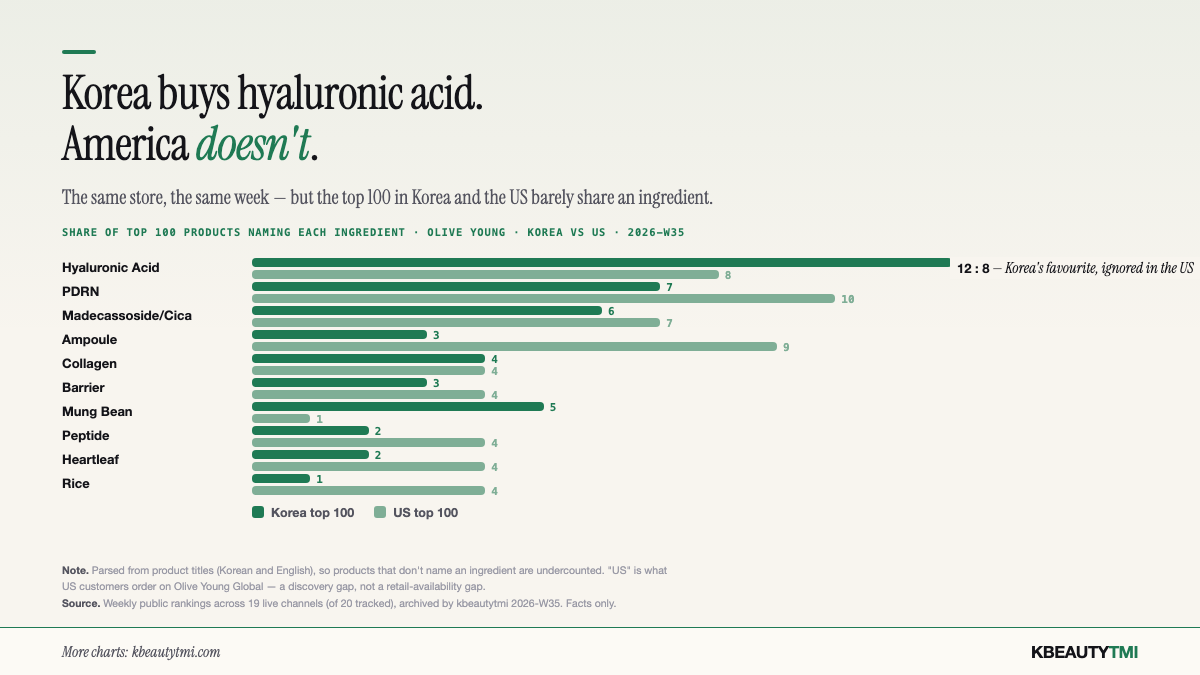
You can read a best-seller chart as a list of molecules, not just brands. In Olive Young's 2026-W35 top 100, we count how many products name each active: hyaluronic acid leads in Korea at 12, followed by PDRN (7) and madecassoside/cica (6). The market has a working vocabulary of actives, and shoppers use it — which is why an ingredient can now carry a product the way a brand name used to.
Korea and the US name different molecules
Read the same retailer's Korean and US-facing top 100 for the same week and they barely share an ingredient. Hyaluronic acid is Korea's most-named active (12) but sits at 8 on the US Olive Young Global list. PDRN — whose search demand is up 561% year over year — is named more in the US (10) than in Korea (7). Rice (1 vs 4) and heartleaf (2 vs 4) skew toward US discovery, while mung bean (5 vs 1) skews Korean. Same store, same week, different molecules. This is a discovery gap in what US shoppers order, not a claim about what is on any physical shelf.
Why ingredient fluency changes the sell
Ingredient fluency makes loyalty stickier and country-of-origin weaker. When a shopper is attached to PDRN or cica rather than to a flag, the brand that explains the active best — its mechanism, its concentration, why it suits a climate — wins the consideration. BeautyMatter calls this the move "from country-of-origin to formula rationale," and reads it as a maturation signal: the market has learned the vocabulary, so the marketing has to earn the sale on the molecule.
What it means for a brand
Lead with the ingredient, not the passport. The brands travelling fastest — into the US, and into fast-rising markets like the Gulf — are the ones whose story starts with a named active and its rationale, because that is the unit the shopper, the search bar and increasingly the AI assistant now read. "Korean" is context. The ingredient is the claim. We track which actives are climbing each week, and where Korea's shelf and its export markets are asking for different ones.
"Shoppers stopped asking for "Korean." Now they ask for the ingredient." — kbeautytmi, 2026-W35. https://kbeautytmi.com/stories/the-market-speaks-in-ingredients-not-brands-2026-w35
↗ Chart image — free to use with credit Free to cite — rankings can't be collected retroactively, so this archive exists nowhere else.