No, K-beauty's Ulta shelf didn't jump six points in a week.
Our Ulta K-beauty reading went from 16.0% one week to 22.0% the next. That is not the shelf moving — it is our scanner. We replaced a human screenshot the software kept mis-reading with a direct feed that reads every brand name, so brands that were invisible last week get counted this week. When the way you measure changes, so does the number, and treating that as a trend is how a chart lies to you.
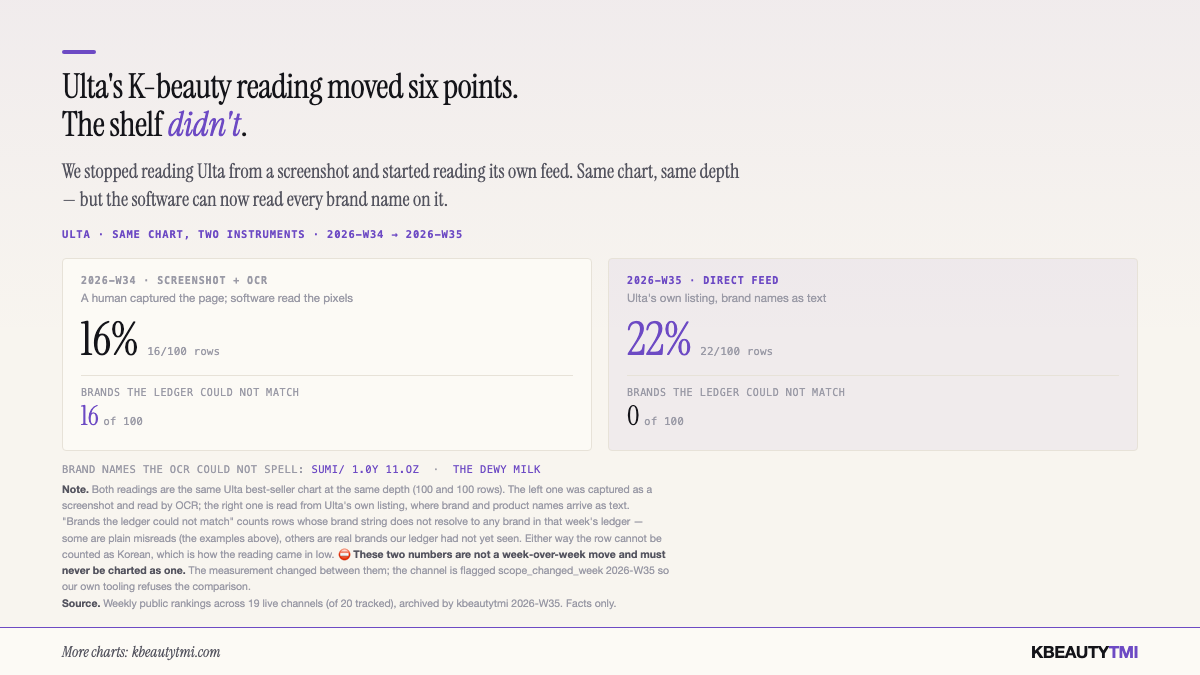
A number on this site moved six points in a week, and the honest thing to do is tell you it didn't. Our Ulta K-beauty reading went from 16.0% in W34 to 22.0% in W35. Nothing about Ulta's shelf changed that fast. What changed is how we read it.
The number moved because the scanner did, not the shelf
W34's Ulta chart came from a human screenshot run through OCR; W35's comes from a direct feed where every brand and product name arrives as text. The old way mis-read brand names badly enough that real products fell out of the count; the new way reads them cleanly. So the six-point "gain" is almost entirely brands that were always on the shelf but were invisible to last week's method — not new K-beauty arriving.
What last week's capture actually said
Here is the receipt. In the W34 saved capture, the #1 row read as "KOPAR KOPAB Jhelry Amco SURREAN BR" — an OCR smear of several stacked labels, not a brand. TATCHA came through as two separate brands, "TATCA" and "Tatcha." Rows like these were counted as not-K-beauty, and a few of them were the difference between 16% and 22%. The shelf didn't gain K-beauty; our count stopped losing it.
Why we block the comparison instead of reporting the jump
When the measurement method changes, what you are measuring changes with it — so the two weeks are not on the same axis. Rather than publish a jump we can't stand behind, we tag the channel with scope_changed_week: 2026-W35, and the code refuses to draw a week-over-week ranking or share comparison across that line. The W35 reading is the more accurate one; we just won't pretend it's a trend off a number we now know was wrong.
The rule: suspect your own pipeline first
A best-seller share that leaps six points in seven days is far more likely to be a measurement change than a market one. So our first suspect for any surprising number is us — our parser, our capture, our definitions — not the shelf. Most of the errors that would otherwise become a confident headline are caught right here, at the boundary between what a scanner read and what was actually on the shelf. That's the unglamorous work that makes the rest of the numbers worth trusting.
"No, K-beauty's Ulta shelf didn't jump six points in a week." — kbeautytmi, 2026-W35. https://kbeautytmi.com/stories/ultas-kbeauty-share-didnt-jump-we-changed-the-scanner-2026-w35
↗ Chart image — free to use with credit Free to cite — rankings can't be collected retroactively, so this archive exists nowhere else.