We now ask four AI engines, not two. Here's the K-beauty they name.
We changed how we listen. Until this week, "what AI recommends" here meant two engines and ten questions. Now it's four engines and sixty-five. Here's the K-beauty they name — and why we're calling it a fresh start, not a week-over-week move.
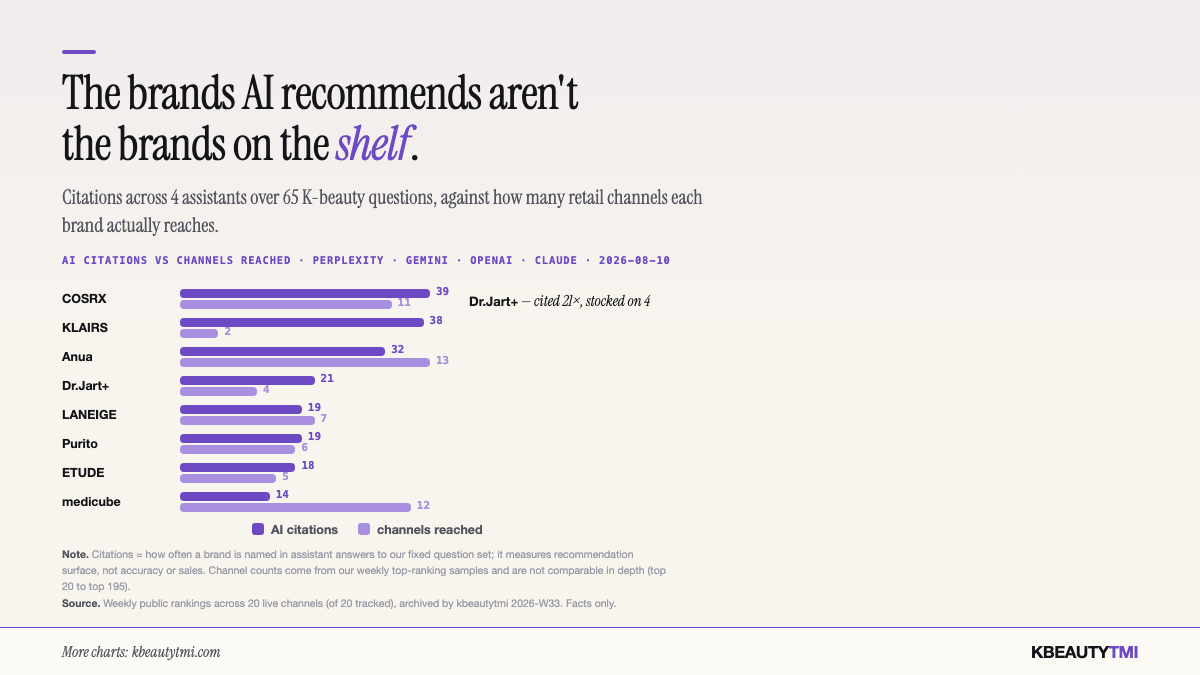
The most honest thing we can do with a measurement is tell you when we change it. This week we widened the one behind our AI leaderboard. Until now, "what AI recommends" on this site meant two engines answering ten fixed questions. Starting this week it's four engines — Perplexity, Gemini, OpenAI and Claude — answering sixty-five. Broader, steadier, and harder for any one model's quirk to swing. It also means this week's numbers start a new baseline, so read them as a fresh snapshot, not a move.
The new leaderboard
Across the four engines, two brands sit neck-and-neck at the top: COSRX (39) and KLAIRS (38), with Anua (32) a close third, then Dr.Jart+, LANEIGE and Purito. It's the internet-famous cohort — the names that fill English-language routines and the articles the models learned from. Ask four assistants for Korean skincare and this is the shortlist they converge on.
Why the numbers look smaller — and why that isn't the story
Last week our top brand showed 124 citations; this week the leader shows 39. That is not a collapse — it's a different ruler. More engines and far more questions spread citations across a wider field, so counts from the new set simply can't be lined up against the old ones. Reading "COSRX fell from 124 to 39" would be comparing two instruments and calling the gap a trend. When we change how we measure, we reset the baseline and say so out loud, rather than paper over the seam to keep a number looking continuous.
Still two different lists
What doesn't change is the split this leaderboard exists to show. How often AI names a brand and how widely it actually charts on retail shelves are two separate readings, and we keep them on separate lists — that's the chart above. A brand the engines love may not have reached the shelf; a shelf staple may be one the engines rarely mention. Citations here are a recommendation surface, not sales and not quality — only what four models surface when someone asks. With four of them answering now, that surface is just a little wider, and a little harder to game.
"We now ask four AI engines, not two. Here's the K-beauty they name." — kbeautytmi, 2026-W33. https://kbeautytmi.com/stories/we-now-ask-four-ai-engines-not-two-heres-the-k-beauty-they-name-2026-w33
↗ Chart image — free to use with credit Free to cite — rankings can't be collected retroactively, so this archive exists nowhere else.