What Korea buys isn't what the world orders. Only 30 of 100 products overlap.
The best-sellers Korea buys at home are mostly not the ones the rest of the world orders from Korea. Comparing Olive Young Korea's top 100 with Olive Young Global's worldwide top 100 for 2026-W31, only 30 of the 100 products appear on both — and the brand that leads the world, REJURAN, sits at #70 in Korea.
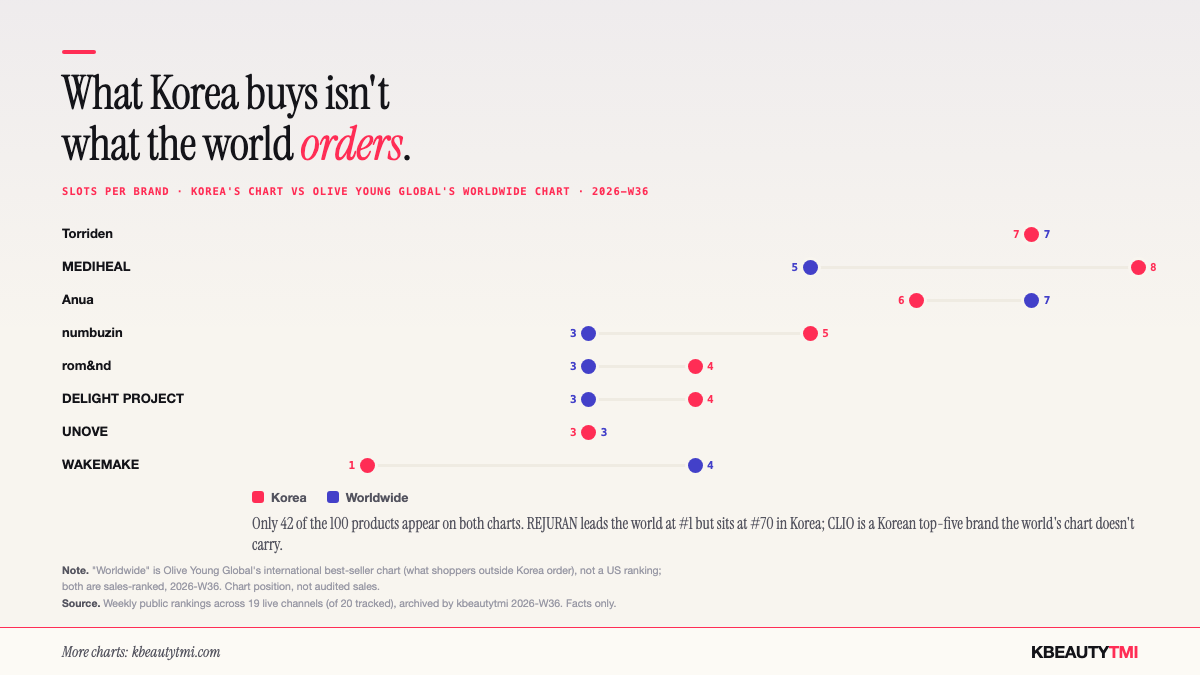
The best-sellers Korea buys at home are mostly not the ones the rest of the world orders from Korea. Set Olive Young Korea's top 100 beside Olive Young Global's worldwide top 100 for 2026-W31 — both live sales rankings from the same retailer — and only 30 of the 100 products land on both lists. Seventy percent of what the world orders from Korea's #1 shop is not what tops the chart inside Korea, and the single sharpest example is the brand sitting at the very top of the world's list.
How different are the two charts?
Different by most of their length. Of the 100 products, 30 appear on both Korea's and the worldwide chart; the other 70 are exclusive to one side. At the brand level the overlap is wider but still partial — 34 brands chart in both markets, while 26 chart only in Korea and 22 only worldwide. So the two audiences share a common core of a few dozen products and brands, and then diverge sharply around it. This is the gap the whole site exists to measure: what a country buys for itself versus what it exports to everyone else's cart.
Which brand best shows the split?
REJURAN. It is the #1 brand on the worldwide chart with 9 of the 100 slots, including the top product — REJURAN's Ultimate Glow & Firm Set — yet in Korea it holds a single slot, at #70. REJURAN built its name on professional, in-clinic "skin booster" aftercare, and its worldwide dominance suggests international shoppers treat Olive Young Global as the place to buy that halo product; Korean shoppers, who can reach the clinics directly, apparently reach for other things. It is the clearest case of a brand the world orders far more than Korea does.
Does it run the other way too?
Yes — some of Korea's favorites don't travel. CLIO, a color-makeup brand, holds 5 slots in Korea's top 100 and none on the worldwide chart at all; Korea's overall leader MEDIHEAL takes 8 slots at home but only 3 abroad, and Torriden's 7 Korean slots shrink to 3. Running the opposite direction, brands like AROMATICA (4 worldwide slots, none in Korea) and Centellian24 (3 worldwide, none in Korea) are ordered internationally while missing Korea's own top 100. Makeup and everyday staples skew Korean; a handful of hero skincare and booster brands skew global.
What this does and doesn't tell you.
It compares two charts from one retailer, and "worldwide" does not mean the United States. Olive Young Global's chart is what shoppers outside Korea order from its international storefront — a mix of many countries, weighted by wherever its overseas customers are — so it is a global-demand signal, not a US one, and we label it that way on purpose. Both lists are sales-ranked for 2026-W31, matched by product ID and normalized brand name, but they are best-seller positions, not unit sales, and one retailer is not either market in full. What the comparison does establish is a real and measurable divergence: the K-beauty the world orders and the K-beauty Korea buys overlap by less than a third, and tracking which products cross from one chart to the other is exactly what these weekly snapshots are for.
"What Korea buys isn't what the world orders. Only 30 of 100 products overlap." — kbeautytmi, 2026-W31. https://kbeautytmi.com/stories/what-korea-buys-isnt-what-the-world-orders-2026-w31
↗ Chart image — free to use with credit Free to cite — rankings can't be collected retroactively, so this archive exists nowhere else.