When you ask AI for a K-beauty recommendation, what does it actually read?
Ask an AI assistant for a K-beauty recommendation and it returns a confident shortlist of brand names — but that shortlist is built from product feeds, reviews and online mentions, not from what actually sells. This week, four of the five brands AI named most don't appear on Korea's real best-seller chart at all.
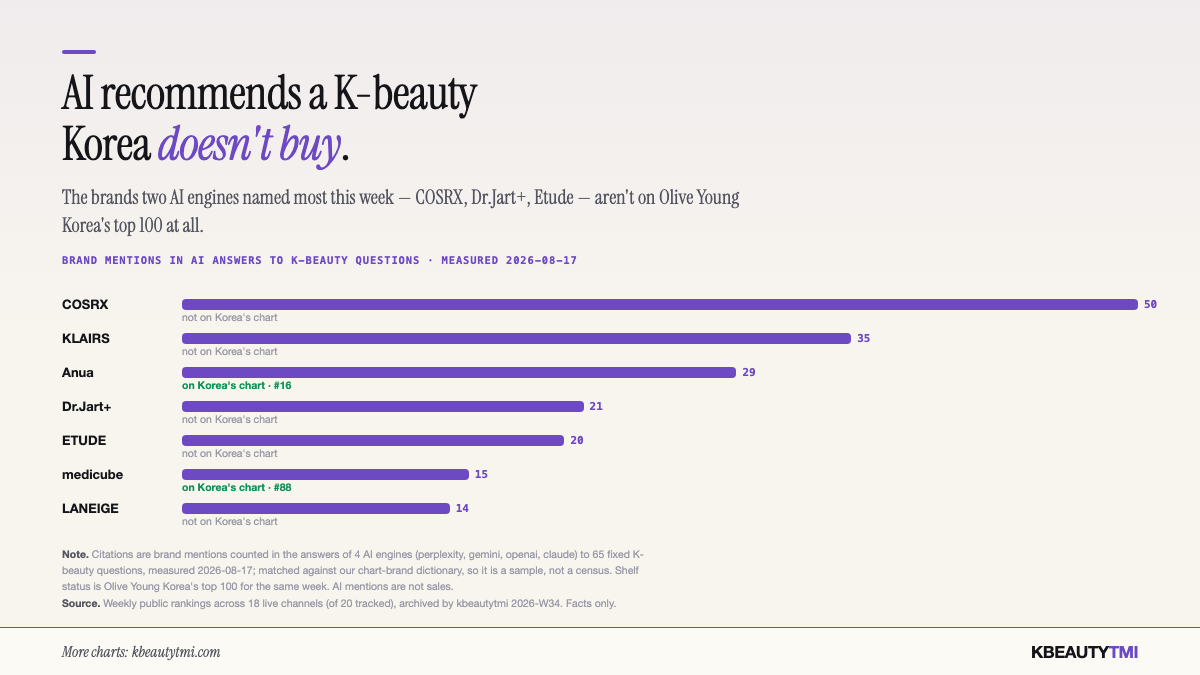
Ask ChatGPT, Perplexity, Gemini or Claude for a K-beauty recommendation and you get a confident shortlist of brand names. It reads like a best-seller list. It usually isn't one — and knowing the difference is becoming a real distribution question, because nearly 80 million Americans now use AI assistants to research and compare purchases this year, per eMarketer.
What an AI assistant actually reads
An AI shopping answer is assembled from what is written about a brand, not from what is bought. To reply, the model pulls three things: structured product data (feeds, availability), content signals (reviews, ratings, FAQs, earned media) and the brand's footprint across the wider web it can retrieve. It never reads a cash register. So the output is a shortlist shaped by online presence — and a brand with little English content can be a quiet best-seller the model simply never names.
The shortlist skews to the internet-famous
Across four AI engines and 65 fixed K-beauty questions, measured 2026-08-17, the most-named brand was COSRX, with 50 mentions — and it does not sit on Olive Young Korea's top 100 for 2026-W34 at all. Neither do KLAIRS (35 mentions), Dr.Jart+ (21) or ETUDE (20). Of AI's five most-named brands, four are absent from Korea's own best-seller chart; only Anua (29 mentions, Korea's #16) appears on both lists. Meanwhile the brands leading Korea's actual chart this week — MEDIHEAL, UNOVE, beplain, AESTURA — the models rarely mention.
Why the two lists diverge
They diverge because they answer different questions. AI names the brands that fill English-language routines — the names in get-ready-with-me videos, Reddit threads and Sephora reviews, the content the model has the most of. Korea buys the mask-and-basics volume brands that dominate its drugstore shelves but generate little English coverage. Neither list is wrong. "An AI recommended it" and "it's a best-seller" are two different claims, drawn from two different pools.
How to read an "AI recommended it" claim
Treat it as a visibility signal, not a sales one. A brand surfaces in AI answers when it has clean product data, real reviews and third-party citations the model can read — being on the shelf isn't enough if the web is quiet about you. That is why we ask the same fixed questions of the same engines every week and keep the record: you can't see inside the model, but you can see who it names, and whether that list is drifting toward or away from what people actually buy. This week, the gap is four brands wide.
"When you ask AI for a K-beauty recommendation, what does it actually read?" — kbeautytmi, 2026-W34. https://kbeautytmi.com/stories/when-you-ask-ai-for-k-beauty-what-it-reads-2026-w34
↗ Chart image — free to use with credit Free to cite — rankings can't be collected retroactively, so this archive exists nowhere else.