Who holds America's beauty shelf — and the two ways they hold it
On the four US best-seller charts where Korean and non-Korean brands land on the same list, 340 chart positions are up for grabs. Korean brands hold 41 of them — 12.1%. This is about the other 88%: who holds it, and a distinction the raw count hides.
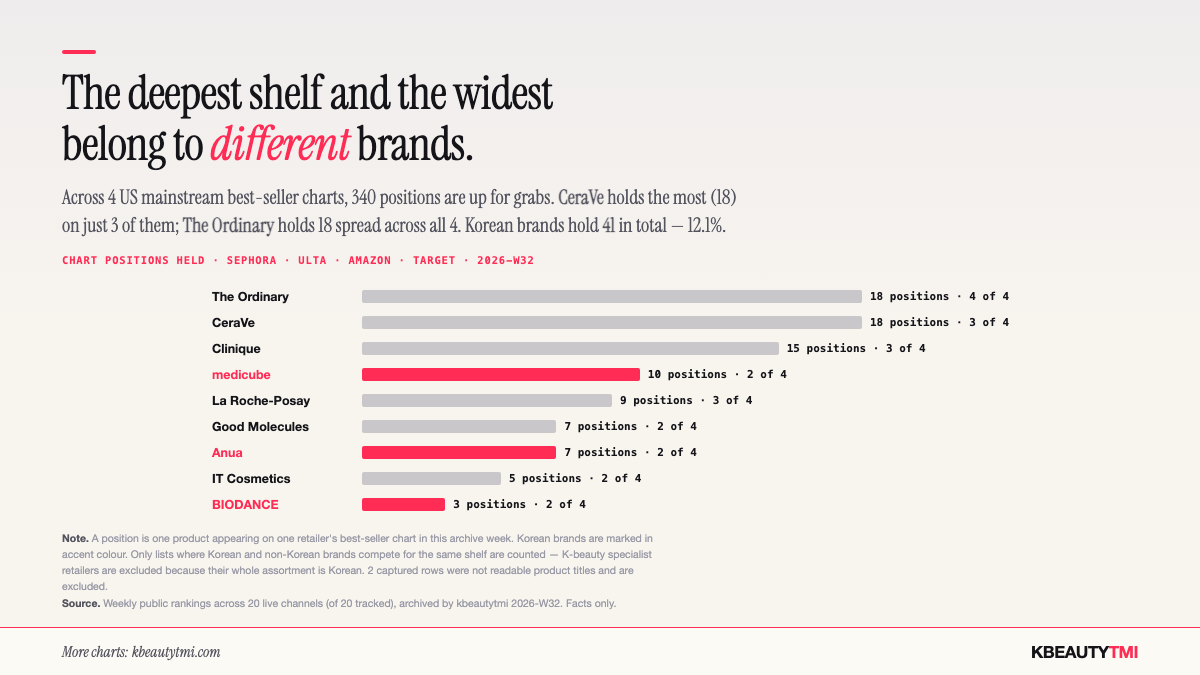
There is a simple question under every K-beauty headline: if Korean brands hold about one in eight positions on America's mainstream beauty charts, who holds the other seven? We can answer it directly. Across the four US best-seller charts where Korean and non-Korean products compete on the same list — Sephora, Ulta, Amazon and Target — there are 340 chart positions in this archive week. Korean brands hold 41. This is the rest.
Who holds the shelf
Two brands tie at the top: The Ordinary and CeraVe, at 18 positions each, with Clinique just behind at 15. The concentration up top is American — mass drugstore skincare (CeraVe, La Roche-Posay) and mass-prestige (The Ordinary, Clinique). Korea's biggest presence is medicube at 10, then Anua at 7. One thing the count settles cleanly: no single brand holds more positions than Korea's thirteen charting brands do together (41). The shelf leader is a category, not a company.
Slots and reach are not the same thing
Here is the distinction the leaderboard hides. The Ordinary's 18 positions are spread across all four charts; CeraVe's 18 are concentrated — a dozen of them on Target alone. And rhode, at 10 positions, holds every single one on Sephora. Same score, opposite strategy: one brand is everywhere-but-thin, another is deep-in-one-aisle. Counting positions alone flattens two completely different ways of owning a shelf — the wide, shallow footprint and the narrow, deep one.
Where Korea's biggest player sits
By that lens, medicube plays the deep-and-narrow game. Eight of its ten positions are on Amazon; it barely appears elsewhere. Korea's strongest mainstream showing this week isn't spread across the shelf — it's stacked in one channel, the same shape as CeraVe on Target or rhode on Sephora. That's not a weakness or a strength on its own; it's a strategy, and it's the one Korea's leaders are running. Whether the next Korean brand widens out or digs in is the thing worth watching.
"Who holds America's beauty shelf — and the two ways they hold it" — kbeautytmi, 2026-W32. https://kbeautytmi.com/stories/who-holds-americas-beauty-shelf-and-the-two-ways-they-hold-it-2026-w32
↗ Chart image — free to use with credit Free to cite — rankings can't be collected retroactively, so this archive exists nowhere else.