Why we started kbeautytmi
A founding note. Two questions kept coming back — from Americans about Korea, and from Koreans about America — and nobody was keeping the receipts. So we started.
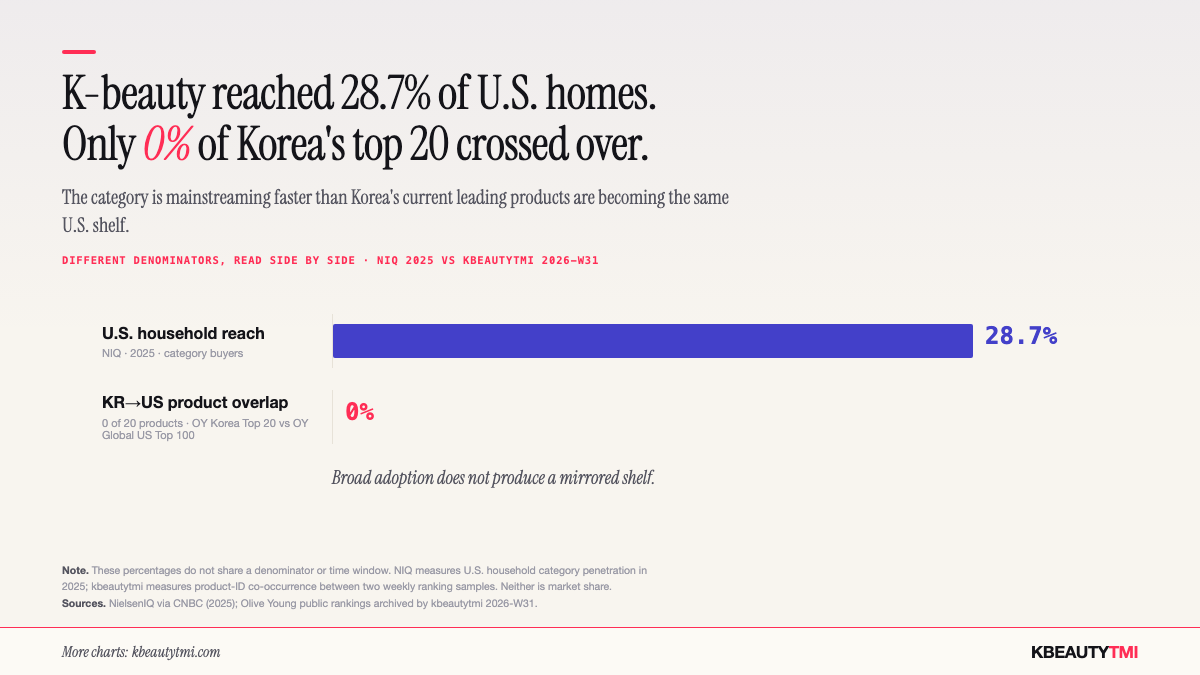
This is the first entry in a journal we'll keep alongside the data. The charts on this site are built to be neutral; this page is the one place we get to say why they exist. Consider it our founding note.
Two questions we kept hearing
The first came from the US. A creator, a shopper, or a buyer would tell us they'd fallen for a Beauty of Joseon sunscreen or a SKIN1004 serum, and then ask, almost sheepishly: “is this actually big in Korea? Do people there really use it?” Underneath that was a warmer curiosity — Korean skin looks good, it glows, so what is the actual routine? K-beauty didn't grow on ingredients alone. It grew on a kind of cultural admiration, and admiration wants to know if the thing it admires is real.
The second question ran the other way. People in Korea — and elsewhere — would look at the headlines (K-beauty is booming in the US, now one of its largest beauty import sources) and ask the mirror-image thing: why? Why does a brand, a product, or an ingredient that's barely visible on a Korean shelf end up winning in America? What are they doing right, and where could anyone even see it happening?
The receipts already existed. Nobody kept them.
What struck us is that most of both questions can be answered without a single opinion. The retailers already publish their best-seller charts. Social platforms already show what people say unprompted. The signals are right there — they just vanish every week, because rankings can't be reconstructed after the fact. So we started saving them. Every week, from Olive Young in Seoul to Sephora, Ulta, Amazon and TikTok Shop in the US, and we keep the archive. That history now exists nowhere else, and it's the quiet foundation under everything here.
Not “what's trending” — where it moves
Plenty of places will tell you what's hot this week. That was never the interesting part to us. The interesting part is direction: a product born in a Korean routine traveling to a US shelf, or an American breakout signal pointing at the next global trend. K-beauty is a migration, and this site is built to read it — from Korean routines to US shelves, and from American breakout signals back to what Korea buys next. Trends are a snapshot; movement is the story.
What we're promising ourselves here
Two rules we don't want to break. First, we witness, we don't predict. When a number surprises us, we assume a parser bug before we assume a story, and when we do forecast, we label the confidence and publish the misses next to the hits. Second, these are shelf positions, not sales. A best-seller rank tells you what a store surfaced, not how many units moved — and pretending otherwise would betray the whole point of keeping honest receipts. We are not affiliated with the brands we cover. The charts don't care who makes the product, and neither do we.
Where this goes
The data desk is the floor, not the ceiling. On top of it we want the curation to get sharper — the brand quietly climbing, the ingredient breaking out in the US, the product that just landed on a chart for the first time — and eventually a community around it, because half the value of a signal is other people seeing it with you. This journal is where we'll think out loud as that happens. If you're here early: thank you. The archive only gets more valuable the longer it runs, and you're reading it on week one.
"Why we started kbeautytmi" — kbeautytmi, 2026-W31. https://kbeautytmi.com/stories/why-we-started-kbeautytmi
↗ Chart image — free to use with credit Free to cite — rankings can't be collected retroactively, so this archive exists nowhere else.