The world orders Korea's clinical actives. Korea buys its calming ones.
The K-beauty ingredients the world orders are not the ones Korea buys for itself. In the 2026-W31 charts, PDRN and glutathione — the clinic-derived, injectable-adjacent actives — are named on more of the worldwide top 100 than Korea's, while heartleaf, centella and collagen are named on more of Korea's. The world reaches for the treatment; Korea reaches for the calm.
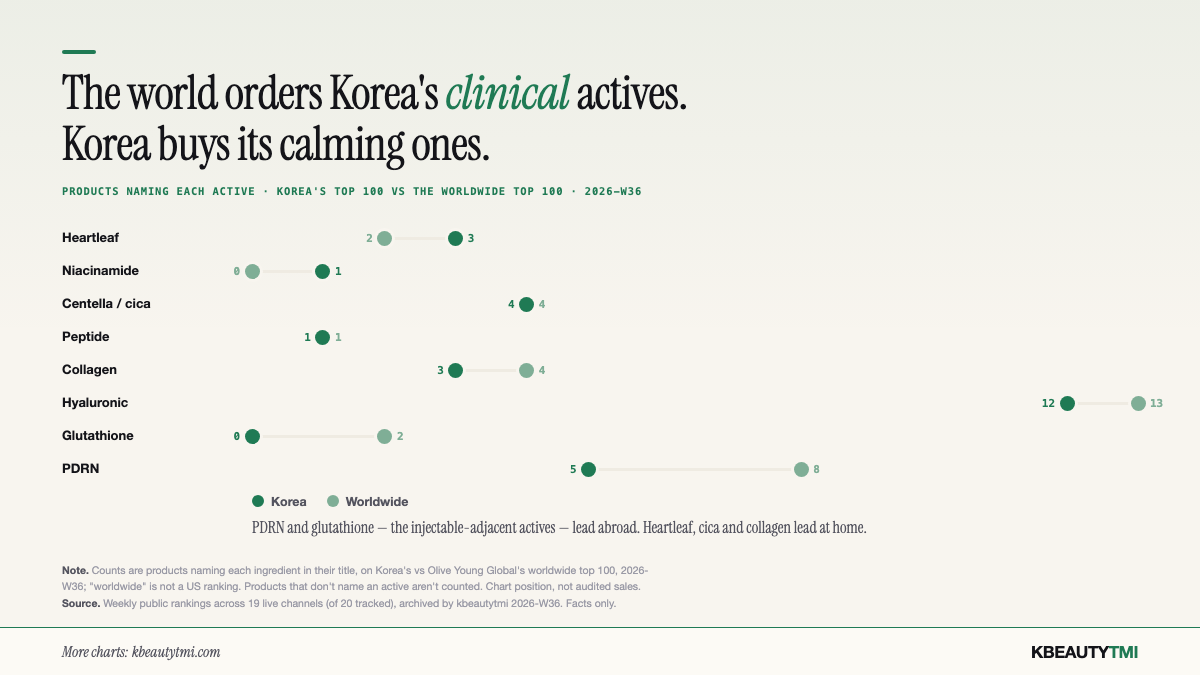
The K-beauty ingredients the world orders from Korea are not the ones Korea buys for itself. Counting how many products name each active in their title, the 2026-W31 worldwide chart leans toward clinic-derived, injectable-adjacent actives — PDRN and glutathione — while Korea's own chart leans toward soothing, barrier and mask ingredients — heartleaf, centella and collagen. It is the same divergence we found at the brand level last time, now visible in the formulas.
What does the world order that Korea orders less of?
The clinical actives. PDRN — the salmon-derived "skin booster" molecule that started in dermatology clinics — is named on 9 of the worldwide top 100 but only 5 of Korea's; glutathione, the brightening active often sold as an inner-beauty or IV treatment, is named on 5 worldwide versus 2 in Korea; peptides appear on 2 of the worldwide chart and none of Korea's. These are the ingredients with a procedure behind them, and they travel: shoppers outside Korea order the at-home version of a treatment they can't as easily get in a clinic.
What does Korea buy that the world orders less of?
The calming ones. Heartleaf (houttuynia) is named on 5 of Korea's top 100 but just 1 of the worldwide chart; centella/cica appears on 5 versus 2; collagen — largely in mask form — on 5 versus 2. Hyaluronic acid leads both charts but still skews Korean, 10 to 7. These are barrier-repair, soothing and hydration ingredients, the vocabulary of Korea's mask-and-toner-pad shelf we mapped earlier in this series. At home, the everyday routine — not the treatment shortcut — is what tops the chart.
Why would the split run this way?
It follows directly from who can reach a clinic. This is the ingredient-level echo of last week's brand finding: REJURAN, a PDRN skin-booster brand, is #1 on the worldwide chart and #70 in Korea. Korean shoppers who want a PDRN or glutathione treatment can book the in-clinic procedure that these products imitate, so the at-home proxy is less of a must-buy; international shoppers, further from those clinics, order the proxy instead. The soothing botanicals run the other way — heartleaf and cica are everyday Korean staples that the rest of the world is still discovering. Export demand concentrates on the halo treatment; home demand spreads across the routine.
What this does and doesn't tell you.
It counts words in titles, not molecules in bottles, and "worldwide" is not the United States. A product is counted for an ingredient only if the name says so, so unnamed actives — and products marketed on brand or format rather than ingredient — are missed, which understates every count and could shift the gaps. "Worldwide" is Olive Young Global's international best-seller chart, a many-country demand signal, not a US one. Both lists are sales-ranked for 2026-W31, and the numbers are small — single- and low-double-digit counts out of 100 — so treat the direction, not the decimal, as the finding. What the direction shows is consistent and repeatable: the world orders Korea's treatments, and Korea buys its routine.
"The world orders Korea's clinical actives. Korea buys its calming ones." — kbeautytmi, 2026-W31. https://kbeautytmi.com/stories/world-orders-koreas-clinical-actives-2026-w31
↗ Chart image — free to use with credit Free to cite — rankings can't be collected retroactively, so this archive exists nowhere else.