YesStyle and iHerb share 58% of their K-beauty brands. They're the same starter pack.
Two weeks ago we found the loneliest pair on our board: Sephora and Ulta, two prestige giants that share almost no K-beauty brands. This week, the opposite pole. Of the K-beauty brands iHerb carries in our sample, 58% also appear on YesStyle — 18 shared brands, the tightest overlap of any channel pair we track. Land on one, and the other is the likeliest next stop.
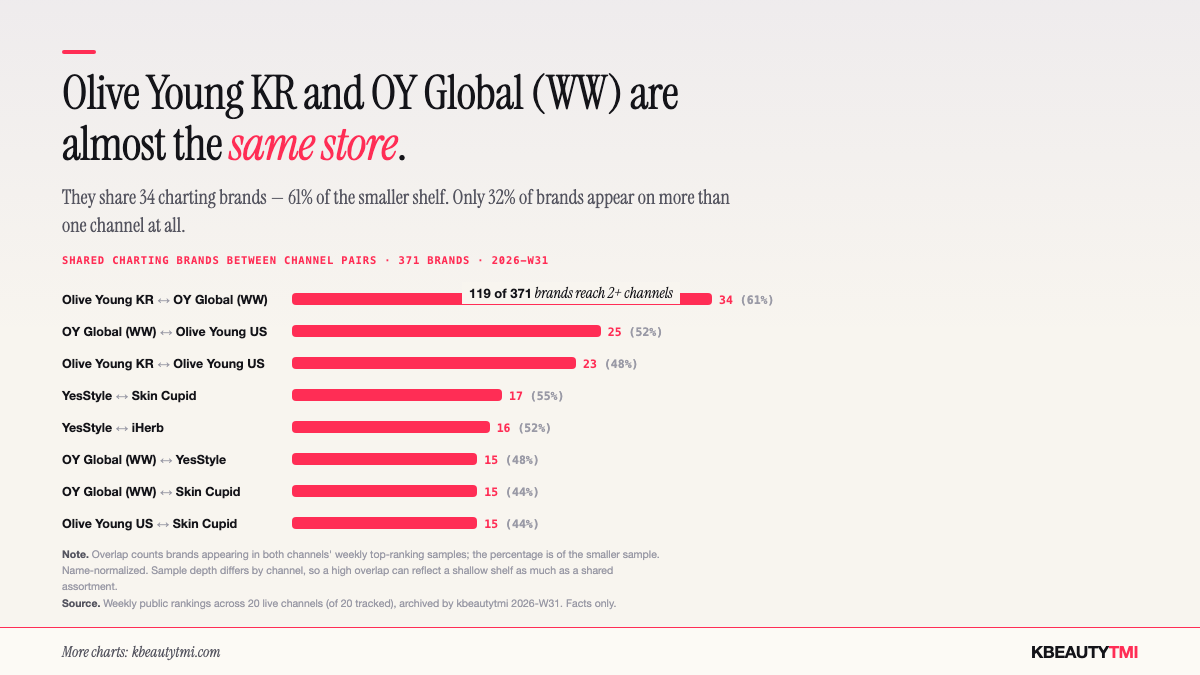
Lab asks a single question: if a brand is here, where does it go next? The answer isn't a guess when two channels are effectively the same shelf. This week they are YesStyle and iHerb: of the K-beauty brands iHerb carries in our sample, 58% also appear on YesStyle — 18 shared brands, the highest overlap of any pair on our board.
Some pairs are twins
Context makes the number louder: across all 247 brands we track, only 31% appear on more than one channel at all. Against that baseline, a pair sharing well over half of one roster is extraordinary — the same brands, ranked by the same kind of shopper. If you wanted one sentence for a brand's US specialty debut, it would be: get onto YesStyle or iHerb, and you have effectively gotten onto both. They are the K-beauty starter pack.
And some pairs are strangers
Hold it against the pole we mapped in Sephora and Ulta, which share almost no K-beauty brands at all. Two prestige retailers, both selling K-beauty, with rosters that barely touch — because they curate for different customers. Two specialty marketplaces, selling to overlapping global K-beauty seekers, converge to nearly the same list. Overlap isn't about size; it's about who the channel is for.
Reading it as probability, not fate
A high overlap is a directional channel read, not a promise. YesStyle and iHerb share an audience and often the same distributors, which is why their charts rhyme — but a brand can sit on one and never reach the other. The value is directional: when we later see a brand appear on YesStyle, this pairing tells us where to watch next. And when a brand breaks the twins — lands on iHerb but not YesStyle — that anomaly is itself a signal worth a second look.
"YesStyle and iHerb share 58% of their K-beauty brands. They're the same starter pack." — kbeautytmi, 2026-W30. https://kbeautytmi.com/stories/yesstyle-iherb-same-starter-pack-2026-w30
↗ Chart image — free to use with credit Free to cite — rankings can't be collected retroactively, so this archive exists nowhere else.